

By Sumayya
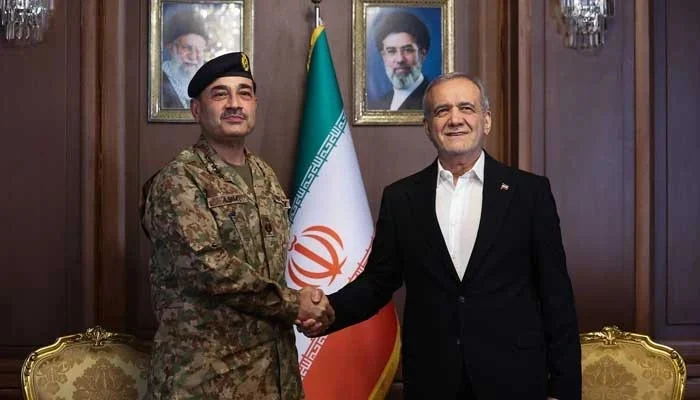
Chief of Defence Forces (CDF) and Chief of Army Staff Field Marshal Asim Munir is scheduled to travel to Tehran on Monday (today) as the United States readies the deployment of what it characterizes as “the greatest financial offensive ever marshalled” targeting Iran, while Tehran has pledged to completely block all oil shipments navigating out of the Gulf “if the economic war continues.”
United States Treasury Secretary Scott Bessent is slated to conduct a media briefing at 2 p.m. EDT (1800 GMT) on Monday, backed by administrative vows to disclose even more stringent penalties against a nation that has navigated near-perpetual economic blockades since the Islamic Revolution of 1979.
Iranian officials stated that CDF Munir’s bilateral mission would form a critical component of collaborative strategies to re-establish stability and safety across the territory, while an official Pakistani administrative contact mentioned that he would evaluate recent regional updates, encompassing the American threat of escalating financial penalties.

The Prime Minister Shehbaz Sharif-headed administration successfully negotiated a fortnight-long armistice connecting both adversarial factions on April 8, which halted a 42-day outbreak of military hostilities, and Islamabad continues to function as a backchannel intermediary relaying diplomatic communications between Washington and Tehran.
Two independent Pakistani administrative contacts validated Munir’s diplomatic itinerary to Reuters. The initial official source detailed that Iran and Pakistan maintain active, unmediated diplomatic lines.
A secondary administrative source clarified that the strategic dialogue would simultaneously evaluate emerging operational realities within the theater of conflict, including U.S. President Donald Trump’s warning of implementing significantly harsher economic counter-measures against Iran.
“He [CDF Munir] will evaluate regional stability protocols under Islamabad’s existing memorandum of understanding, Trump’s recent policy warnings, the overarching geopolitical landscape materialized after the Pakistan-Turkiye-Saudi Arabia trilateral accord, and ongoing Houthi maritime security challenges during his consultations with Iranian leadership,” the administrative source specified.
The strategic visit unfolds against a backdrop of intensified volatility as Tehran vows a kinetic intervention against upcoming American economic penalties that threaten to exacerbate the structural vulnerabilities of the Islamic Republic’s struggling financial system. “With the morning light arrives a financial D-Day — an unprecedented fiscal deployment unmatched in historical statecraft against a foreign competitor,” Bessent asserted within an analytical column featured in the Financial Times on Sunday.
A significant number of individuals have lost their lives, predominantly within Iranian and Lebanese territories, since the joint operational campaigns by Washington and Tel Aviv commenced on February 28, dismantling a vast portion of Tehran’s traditional defense apparatus and generating deep economic hardship alongside the termination of Iranian Supreme Leader Ayatollah Ali Khamenei. Nevertheless, the clerical regime has maintained a sufficient inventory of ballistic assets and unmanned aerial vehicles to engage regional maritime networks and jeopardize commercial tankers traversing the Strait of Hormuz, reducing maritime traffic within the vital channelling artery to a virtual paralysis and destabilizing international energy markets.
The precise developmental threshold of Tehran’s atomic framework, which American and Israeli strategists intend to dismantle entirely, remains unverified. Without detailing specific measures, Bessent signaled the U.S. would target “fearful nations” practicing “appeasement” by sustaining engagement with Iran’s economic and financial system, advising they “consider the consequences of sustaining it,” according to the Financial Times. Iran has braced for these sanctions by issuing strong statements hinting at a major military response, with Supreme National Security Council secretary Mohsen Rezaei suggesting retaliatory economic measures. You can read the original reporting at Financial Times.
“Should the financial conflict persist, not a single drop of crude will find its way to international markets, neither traversing the Strait of Hormuz nor originating from any alternative terminal within the Persian Gulf,” Rezaei asserted within a public social media statement. “Tehran will classify any sovereign nation’s involvement in or backing of Washington’s financial campaign against the Iranian population as a direct declaration of hostility.”
The U.S. Treasury Secretary had previously petitioned Beijing to align with American objectives, pointing out that China relies on the Gulf territory for 50 percent of its overall petroleum acquisitions. A diplomatic representative for the Chinese embassy based in Washington countered with a formal notification emphasizing that “punitive measures and structural coercion fail to fix the underlying dilemma,” while simultaneously advocating for immediate backchannel negotiation.
The Iranian economic framework was already enduring severe strain from global trade blockades well before the joint American and Israeli offensive crippled major components of its state utility networks. Even though administrative figures in Tehran maintain a publicly unyielding posture, internal strategists have cautioned that subsequent fiscal penalties could amplify societal distress, spark localized civil resistance, and structurally undermine the domestic authority of the Islamic Republic.
Tehran originally entered the military theater navigating high inflation indices, a depreciating currency value, severe utility blackouts, pre-existing sanctions, and deep internal structural imbalances; it must now simultaneously manage devastated public assets, severed trade routes, diminished manufacturing outputs, and the massive financial burdens of post-conflict reconstruction.
Given the complete lack of direct, face-to-face bilateral discussions between Washington and Tehran—which were last convened in June within Switzerland—alternative regional actors, encompassing Qatar, Pakistan, and Turkiye, have actively sought to facilitate a diplomatic resolution. The ongoing joint U.S.-Israeli bombardments across Iran alongside parallel Israeli operations within Lebanon have claimed thousands of lives and forced millions from their communities, while the Pentagon has confirmed 18 American service members killed and upwards of 750 personnel wounded throughout the hostilities.
