

By Sumayya
In a major move to strengthen Middle Eastern ties, Pakistan and Kuwait have finalized a new treaty called the Protocol Agreement-2026. This pact directly expands upon the older Defence Cooperation Agreement-2023, creating a much larger and more advanced system for joint military operations, shared security tactics, and technical defense exchanges between the two nations.
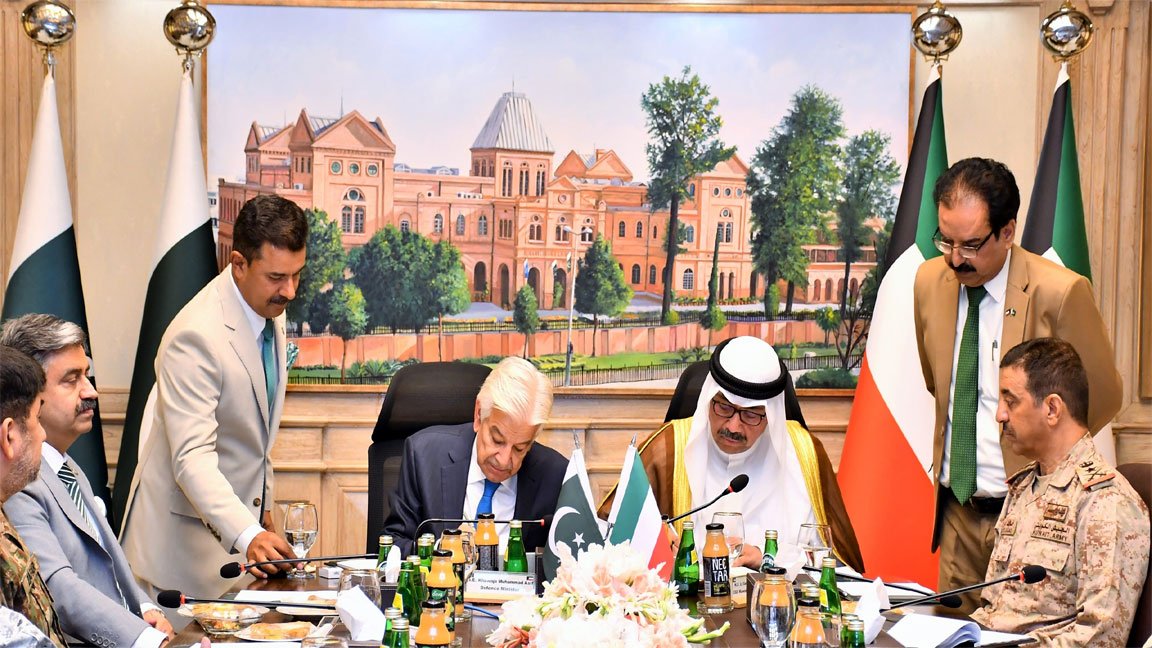
The bilateral defense pact was officially finalized during a high-profile strategic assembly convened in Rawalpindi today, where Pakistan’s Federal Minister for Defence, Khawaja Muhammad Asif, received an influential military and diplomatic delegation representing the State of Kuwait.
The visiting Gulf Arab contingent was directly spearheaded by Kuwaiti Defence Minister Sheikh Abdullah Ali Abdullah Al-Saleem Al-Sabah, who was accompanied by the Chief of General Staff of the Kuwaiti Armed Forces, Lieutenant General Khalid Darj Saad Al-Shriaan, to hold comprehensive talks aimed at solidifying long-term security integration and institutionalizing defensive ties between both partner nations.

Pursuant to the operational parameters established within the newly ratified bilateral framework, the Armed Forces of Pakistan will systematically deploy specialized technical assistance, professional expertise, and tactical resource personnel to support the Armed Forces of the State of Kuwait. This comprehensive deployment will span multiple critical defense sectors, including high-level institutional training programs, organizational capacity-building initiatives, advanced territorial border management strategies, and various supplementary fields of defense collaboration mutually prioritized by both military commands.
The finalization of this agreement serves as an explicit indicator of the profound institutional trust, absolute mutual respect, and convergent strategic paradigms that have historically underpinned and sustained the multi-generational security relationship connecting the two brotherly Islamic nations.
Furthermore, leadership from both states utilized the strategic forum to formally re-verify their shared organizational resolve to continuously expand and solidify this bilateral defense partnership, positioning it as a core pillar for the preservation of collective national security, maritime safety, and overarching geopolitical stability across the wider region.
Throughout the high-level consultation, administrative and military leaders evaluated a wide-ranging agenda of mutual strategic interests, placing a deliberate and concentrated focus on expanding existing bilateral defense ties, optimizing joint security cooperation frameworks, and building more resilient pathways for sustainable defense connectivity between Islamabad and Kuwait City.
