

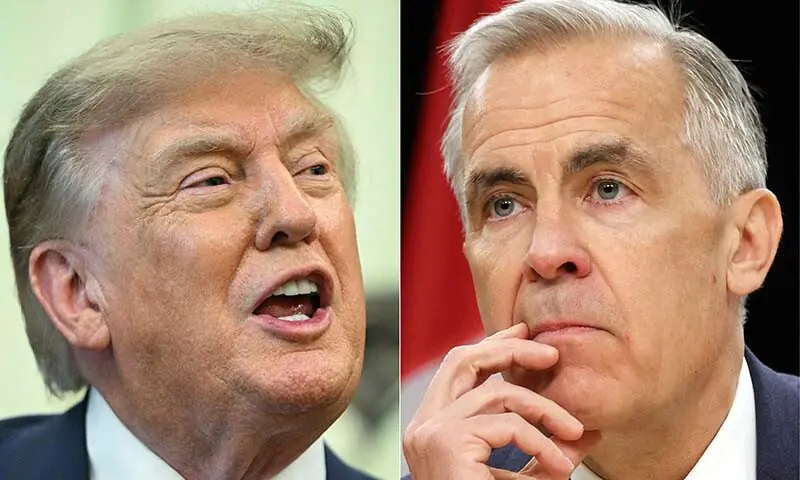
United States President Donald Trump announced on Monday his intention to double import tariffs on Canadian automobiles starting next year, pushing the neighboring allies closer to a full-scale trade war. This move marks an escalation in trade tensions between the two nations.
“Beginning January 1, 2027, import taxes on all passenger cars, commercial trucks, automotive components, and steel will jump to 50 percent,” Trump announced via his Truth Social account.
Presently, the existing American tariff structure influencing Canadian automotive imports maintains a 25 percent rate levied against non-domestic components, whereas steel entering the United States from international suppliers routinely encounters a 50 percent customs duty.
The newest warning issued by Trump materialized swiftly after the adjacent North American partners faltered during Friday’s high-stakes negotiations to orchestrate a compromise that would prevent the activation of fresh 50 percent US taxes targeting a designated list of Canadian export items. Consequently, those specific trade penalties officially entered into force over the weekend on Saturday.

In a direct countermove, Canadian Prime Minister Mark Carney subsequently declared a slate of reciprocal punitive tariffs aimed squarely at American economic sectors, executing this measure immediately after abandoning bilateral discussions that he publicly characterized as an entirely unacceptable arrangement.
These incoming Canadian financial sanctions are explicitly designed to penalize the United States steel manufacturing and dairy production sectors, while simultaneously encompassing diverse industrial fields including farming machinery, wood pulp and paper manufacturing, alongside consumer and industrial electronics. This comprehensive pushback formulated by Ottawa is officially scheduled to go into active operation beginning September 8.
For its part, the White House asserted that Canada was guilty of unfair and biased regulatory practices directed against American wine and spirits, vehicular manufacturing, and dairy commodities as the fundamental justification for enforcing the new 50 percent trade levies. Trump had previously pushed back the legal enactment of these penalties by a seventy-two-hour window during the preceding week, a pause granted while Washington and Ottawa aggressively ramped up diplomatic discussions in a final attempt to finalize a treaty.
Canadian diplomats, led by Dominic LeBlanc, failed to reach a new trade agreement with U.S. Trade Representative Jamieson Greer in Washington, despite hours of intense negotiations. New U.S. tariffs, affecting 5.5% of Canadian goods, triggered a freeze in bilateral talks, with both sides failing to set a timeline for future meetings.
