

By Haris Ahmed
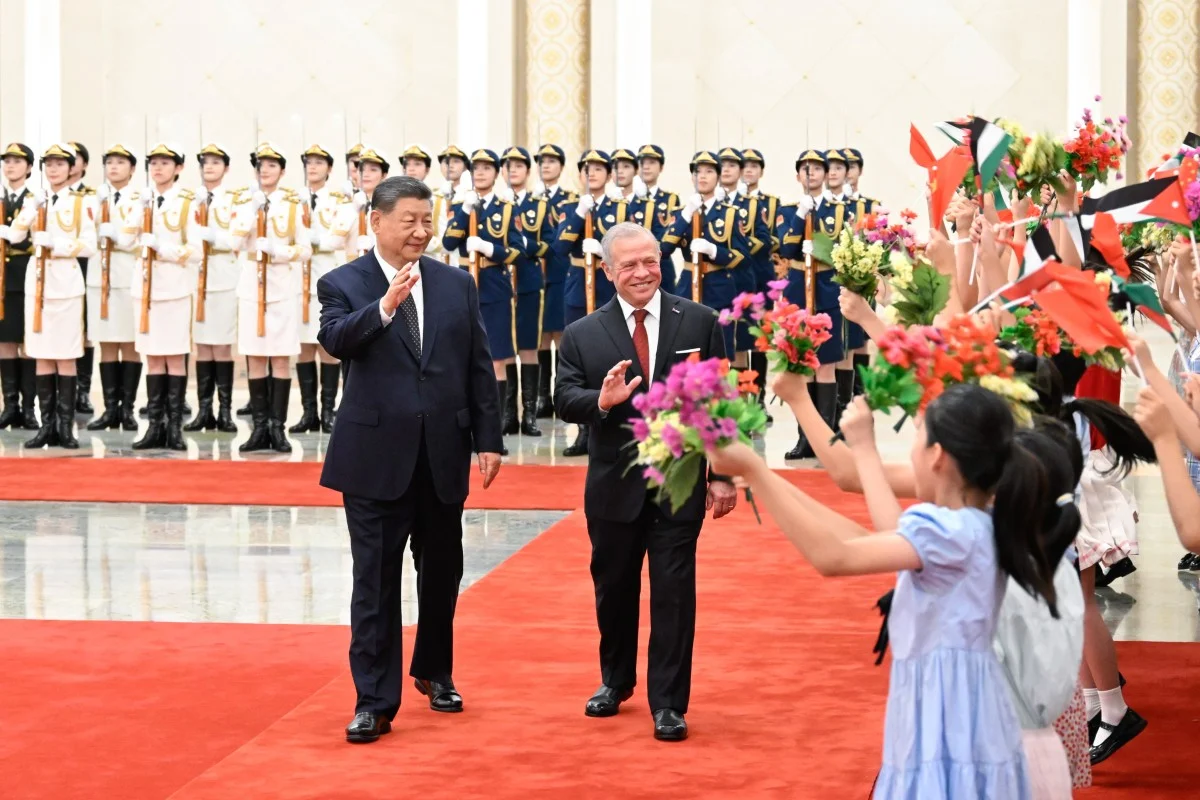
The leadership of China and Jordan jointly demanded the restoration of shipping traffic through the Strait of Hormuz, while urging that the current ceasefire between Washington and Tehran be upheld. This official statement was released during King Abdullah’s state visit to Beijing.
The two states additionally expressed their desire for a holistic resolution targeting the underlying origins of regional instability via diplomatic discourse and mediation, while guaranteeing absolute adherence to the independence, safety, and borders of Middle Eastern nations.
Negotiations aimed at brokering peace between Washington and Tehran have currently ground to a halt, leaving the maritime corridor—characterized in the bilateral communique as a critical artery for global mercantile operations and oil markets—largely blocked to merchant fleets.

The official communique, published following the monarch’s high-level consultations with President Xi Jinping alongside other senior dignitaries on Monday, urged the immediate re-establishment of standard maritime passage through the strategic channel.
Furthermore, both nations condemned Israel’s “perilous provocative maneuvers” within the West Bank and East Jerusalem, as reported by the state-run media network Xinhua.
The bilateral partners voiced profound anxiety regarding Israeli operations, highlighting the expropriation of territory, the development and broadening of residential outposts, and maneuvers designed to modify the traditional and statutory status of Muslim and Christian sacred locations throughout Jerusalem.
“Each party stressed that every illegitimate policy intended to seize fragments or the entirety of the captured West Bank region is completely invalid, maintaining that these initiatives breach global statutory frameworks and United Nations declarations,” the joint proclamation clarified.
Lately, the Israeli government initiated bidding processes for approximately 1,200 outpost residences situated east of Jerusalem, provoking intense global disapproval for an initiative broadly interpreted as a strategy to isolate the West Bank further and obstruct the realization of a sovereign Palestinian nation.
Amman additionally cautioned regarding an immediate hazard of an Israeli takeover at Jerusalem’s Al-Aqsa mosque, the premier Islamic holy place in the municipality, following an intrusion by approximately 2,000 right-wing activists and homesteaders the preceding month.
Throughout the convention, Xi pledged to intensify joint ventures with Jordan within fundamental industries, specifically commerce, infrastructural development, and resource extraction. He noted that this partnership could extend toward fields like the electronic marketplace, machine intelligence, and sustainable power sources.
Concurrently, the Jordanian sovereign promised to scale up joint efforts in scientific and technological domains, invited additional capital injection from Chinese corporations, and praised Beijing’s unbiased position concerning Middle Eastern diplomatic matters, as reported by the Chinese state media network CCTV.
The twin governments additionally inked several bilateral pacts covering international relations, legal systems, commercial transactions, and manufacturing logistics. They furthermore committed to strengthening their overarching geopolitical alliance after the summit.
The king’s state visit to China unfolds while Jordan finds itself caught in the crosscurrents of the American military campaign against Iran. Notwithstanding Amman’s formal non-aligned posture, domestic military installments accommodating United States troops have faced recurrent strikes from Iranian units.
Monday’s meeting came hours before Washington was set to announce what US Treasury Secretary Scott Bessent has described as the “toughest” sanctions against Iran in history.
There has been an international push to de-escalate the conflict, which continues to unsettle the Middle East and the global energy market. However, six months after the war began, hopes for a diplomatic breakthrough have faded.
During the previous week, Beijing received Iran’s deputy foreign minister, Kazem Gharibabadi, who updated Chinese officials regarding recent events in the Gulf during a consultation with his counterpart, Miao Deyu. Based on statements from the Chinese foreign ministry issued on Sunday, Miao reconfirmed China’s resolve to energetically foster peace and stimulate diplomatic dialogue.
That same Sunday, Jordan facilitated a high-level summit between Syrian and Israeli representatives focused on securing a de-escalation following Israeli military strikes on Syrian soil, according to details shared by the state-run Syrian Arab News Agency via a diplomatic contact.
Concurrently, Kuwaiti Foreign Minister Sheikh Jarrah Jaber Al-Ahmad Al-Sabah arrived in Beijing on Monday to fulfill a two-day official visit following an invitation from Chinese Foreign Minister Wang Yi.
The compact Gulf nation is separated from the Iranian mainland by a slim section of Iraqi territory and has experienced severe damage from Iranian missile and drone strikes since the outbreak of hostilities.
The country accommodates multiple major United States military installations, notably Camp Arifjan, which functions as the primary logistics, supply, and command center for regional operations.
In the meantime, Jordan—physically positioned between Israel, the West Bank, Syria, and Iraq—has been forced to maintain a sensitive equilibrium between unstable regional forces and conflicting global powers.
Historically reliant on United States defense support and economic subsidies, Amman confronts escalating strain from Iranian military offensives alongside international funding reductions instituted by US President Donald Trump’s administration.
Though it remains firmly within the American defense sphere, Jordan has attempted to broaden its international alliances and bolster its domestic economy by intensifying its engagement with Beijing.
The week-long diplomatic tour, which commenced on Tuesday and concluded on Monday, represented Abdullah’s ninth official journey to China since inheriting the throne from his father 27 years prior.
Throughout the itinerary, Abdullah toured Shanghai and Shenzhen—two premier centers for machine intelligence and automated technologies—prior to arriving in the Chinese capital city.
In a statement delivered to Xinhua ahead of his travels, the monarch emphasized Beijing’s critical function in upholding global stability and defense frameworks.
During that discussion, the king articulated Jordan’s commitment to a two-state framework designed to build a sovereign Palestinian country next to Israel.
He noted that Amman intended to collaborate with Beijing as a major world power to leverage its significant authority and global platform to assist in advancing the creation of a two-state framework.
Approximately 50 percent of the nation’s residency traces its roots back to Palestinian ancestry.
Abdullah furthermore observed that growing Sino-Arab relationships demonstrated a shared objective for collaborative growth, adding that Beijing has served as a vital ally to the country’s state departments by providing instructional workshops and enhancing the nation’s alternative power resources and resource independence via financial investments.
Jordan has rapidly transitioned to renewable energy, with green power rising from under 1% to 27% of its electricity mix in a decade, aiming for 40% by 2035 . Supported by nearly 89% of China’s $3.56 billion investment in the kingdom, this energy shift aligns with expanding trade that made China Jordan’s top trading partner, with bilateral commerce highlighting Chinese machinery exports against Jordanian raw material sales.
