

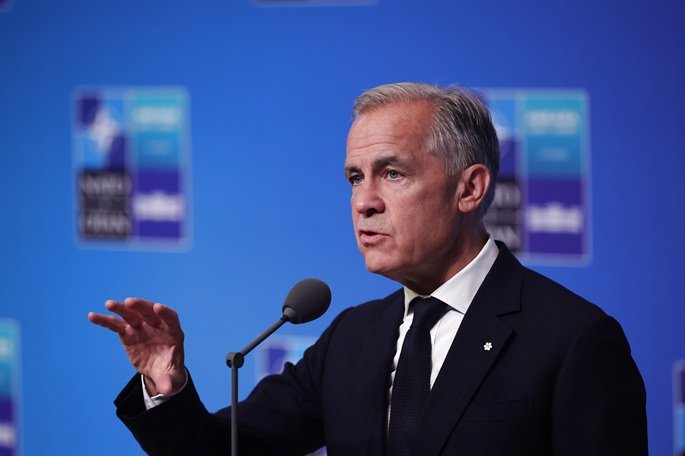
Commercial discussions between Washington and Ottawa disintegrated late Friday, initiating a 50% US tariff on approximately $28 billion in Canadian goods at 12:01 a.m. ET, according to ANI. Prime Minister Mark Carney recalled negotiators to Ottawa, labeling the American demands “unfair and uneconomic.” For more, visit ANI.
Through a formal announcement broadcasted on the social media platform X, Carney affirmed that Canada intends to strike back on an equal financial scale, matching the $28 billion in duties to safeguard domestic laborers and corporate enterprises.
A Permanent Shift in Cross-Border Relations
The Prime Minister emphasized that the federal administration has long acknowledged a profound transformation within the American political landscape, meaning a return to historical diplomatic norms is no longer possible. “We have recognized from the beginning that America has changed, and that we will not return to our old relationship. Our government understood, before many, that America is altering all its trade relationships. Putting tariffs on its closest allies and charging for access to its vast market,” Carney noted.

Negotiating Under New Global Parameters
Carney elaborated on the strategic environment in which Canadian diplomats have been operating. The overarching objective was to secure a balanced treaty that would guarantee optimal entry into the American marketplace while establishing enhanced economic stability for Canadian commercial entities and the workforce. Throughout the intense diplomatic process, the priority remained focused entirely on delivering the most advantageous outcome for the population, rather than rushing to meet an arbitrary time limit or accepting concessions at an unreasonable economic cost.
Insufficient Progress to Meet Canadian Standards
The Prime Minister concluded by addressing the trajectory of the discussions. He acknowledged that while substantial forward movement had been achieved over the past several weeks to strengthen Canada’s leverage and improve its strategic position, the final compromises demanded by the American administration ultimately failed to align with the core national objectives established by Ottawa.
“As a result, this evening, I have decided to suspend trade negotiations with the U.S. and have directed Canada’s negotiators to return to Ottawa,” he said.
“They have worked hard, in good faith, to defend the interests of Canadians throughout these negotiations up until the very last minute. However, last-minute changes in the U.S. proposed terms were unfair, uneconomic, and called into question the reliability of any deal,” he added.
Carney further said that the US intends to impose a 50 per cent tariff at midnight on roughly USD 28 billion worth of Canadian goods, adding that Canada would “match those tariffs dollar for dollar” to protect its workers and businesses.
“In the coming days, the government will introduce additional measures to support Canadian workers and businesses, building on the nearly $25 billion in support provided over the past 18 months,” he said.
The Canadian Prime Minister said the government’s broader economic strategy was focused on strengthening the domestic economy and diversifying partnerships abroad.
He said Canada was advancing nearly USD 500 billion in major infrastructure projects while also working to unlock new export markets for Canadian businesses.
“Our existing free trade deals already provide Canada with preferential access to 1.5 billion consumers, and we are on track to double that market access by the end of this year,” Carney said.
He further claimed that Canadian economic growth was accelerating and the country was on course to record the second-fastest growth in the G7 over the next two years.
“Our economy is creating jobs at four times the rate of the United States. Our exports to non-U.S. markets are on track to double over the next decade. Foreign direct investment in Canada is at its highest level in two decades, running at twice the rate of our nearest G7 competitor,” he said.
“Canada now ranks as the most attractive country in the world for infrastructure investment,” Carney added.
“Canada has what the world wants. And we will not allow any nation to determine our future. We will set our own course to keep building Canada strong for all,” he said.
Meanwhile, Washington hit back, with the US Trade Representative calling it a “missed opportunity for Canada” and accusing Ottawa of walking back commitments and adding new demands. The US said it had offered sector-specific relief in steel, aluminium, autos and lumber.
“This is a missed opportunity for Canada to partner with the United States, which is the fastest-growing economy in the G7,” the US Trade Representative said.
“Despite the US offer to Canada to receive the best treatment of any major exporter to our market, new demands and walkbacks of other commitments by Canada have upended the careful balance reached in the past days,” the US Trade Representative said in a post on X.
It also accused Canada of continuing to maintain its “prolonged retaliation” against the United States, including “flat-out prohibitions on certain American goods and services”.
“For decades, Canada has enjoyed the most favourable access to the U.S. market of any country. And from the beginning of President Trump’s trade program, Canada has continued to enjoy the best treatment in the world, even after – like China – retaliating against the United States,” it said.
The US Trade Representative said that Washington had agreed this week to provide even better treatment to Canada, including significant tariff reductions on steel, aluminium, autos and lumber.
“The U.S. offer was also forward-looking, and included a historic economic and national security partnership to cooperate on export controls, combat transhipment, enhance digital trade, and align certain external tariffs,” it said.
According to the statement, the offer would have included supply chain coordination on aerospace, complementary actions to address unfair trade practices, critical minerals cooperation, increased enforcement against imports produced with forced labour and the announcement of formal US-Mexico-Canada Agreement (USMCA) negotiations.
The latest development comes amid growing efforts by countries to diversify trade partnerships in the wake of the Trump administration’s tariff measures.
According to a report by Canada’s Office of the Chief Economist on the country’s trade landscape, exports to the US fell 3.7 per cent last year amid global shocks and trade tensions.
The decline was offset by an 11.1 per cent increase in exports to non-US markets, which now account for 32.8 per cent, or almost one-third, of Canada’s total exports — the highest share in four decades.
