


By Sumayya
Meta Platforms, the parent organization controlling Facebook and Instagram, finalized an agreement on Wednesday to resolve an extensive legal dispute centered on social media addiction claims brought forward by California alongside several other states.
According to an official corporate release issued by Meta, the terms of the resolution mandate a financial commitment of roughly $18 billion, which is earmarked by the states to support online safety programs for younger demographics and other regional state objectives.
Documentation submitted to the court indicates that the tech conglomerate formally disputes the claims made against it and rejects any structural legal liability to the group of 29 states involved as plaintiffs in the matter.

The judicial filing outlines specific behavioral mandates, showing that Meta has committed to implementing restricted operational windows and late-night blocks for adolescent profiles, alongside deploying stronger age verification systems to block underage individuals from accessing the networks or viewing age-restricted materials.
Under the conditions of this comprehensive legal resolution, adolescent profiles will automatically default to a maximum usage window of two hours per day combined across the Facebook and Instagram applications. The tech firm clarified that young individuals will require explicit parental authorization before they can bypass or turn off this two-hour operational cap.
Furthermore, Meta has agreed to modify its user interface by automatically hiding the visible count of likes on content published by teenagers and completely blocking access to what the corporation classified as extreme digital cosmetic filters.
The enterprise also detailed that young subscribers will gain the operational flexibility to select a non-algorithmic chronological feed as their standard landing display, ensuring their content stream is not curated by automated recommendation software, while also receiving the option to completely turn off the automatic playback function for digital videos.
The legal resolution additionally mandates that the technology conglomerate develop supplementary mechanisms designed specifically to assist parents and legal guardians in safeguarding their offspring across digital spaces.
California Attorney General Rob Bonta, who served as the primary leader for the collective state lawsuit, articulated within an official announcement that the prosecuting parties had successfully achieved a binding agreement with Meta which will render social media environments fundamentally less hazardous for youth and deliver an immensely positive impact for young individuals and their household circles.
“Meta has formally consented to executing sweeping structural reconfigurations that will substantially lower the probability of developmental injuries stemming from its digital applications, and these changes are slated for implementation within a matter of months,” Bonta clarified.
In an independent press briefing, Meta’s chief legal counsel C.J. Mahoney observed that the regulatory structure negotiated through these discussions will equip parents with the capability to effortlessly supervise and direct the specific ways their children interface with corporate applications.
The technology enterprise simultaneously utilized the occasion to urge competing social media networks, explicitly referencing platforms such as TikTok and YouTube, to adopt identical operational adjustments.
“Given that adolescent users shift seamlessly across a multitude of digital applications, establishing a comprehensive, industry-wide strategy is absolutely essential. Consequently, we urge our market contemporaries, TikTok and YouTube, to integrate this newly designed framework without any subsequent delay,” Mahoney asserted.
Media representatives representing TikTok and Google, the corporate entity that controls YouTube, refrained from providing immediate responses to journalistic inquiries seeking statements regarding the judicial settlement or Meta’s explicit public demand for an industry-wide integration of the upgraded protection mechanisms.
The publicized resolution remains contingent upon receiving formal validation from a presiding judicial authority. A few hours following the initial public disclosure, Judge Yvonne Gonzalez Rogers stated that she maintained a positive inclination toward validating the agreement, though she required a supplementary window of time to comprehensively analyze all parameters of the legal documentation.
This major corporate concession materialized exactly one day after Instagram’s chief executive officer, Adam Mosseri, provided formal testimony inside a California courtroom.
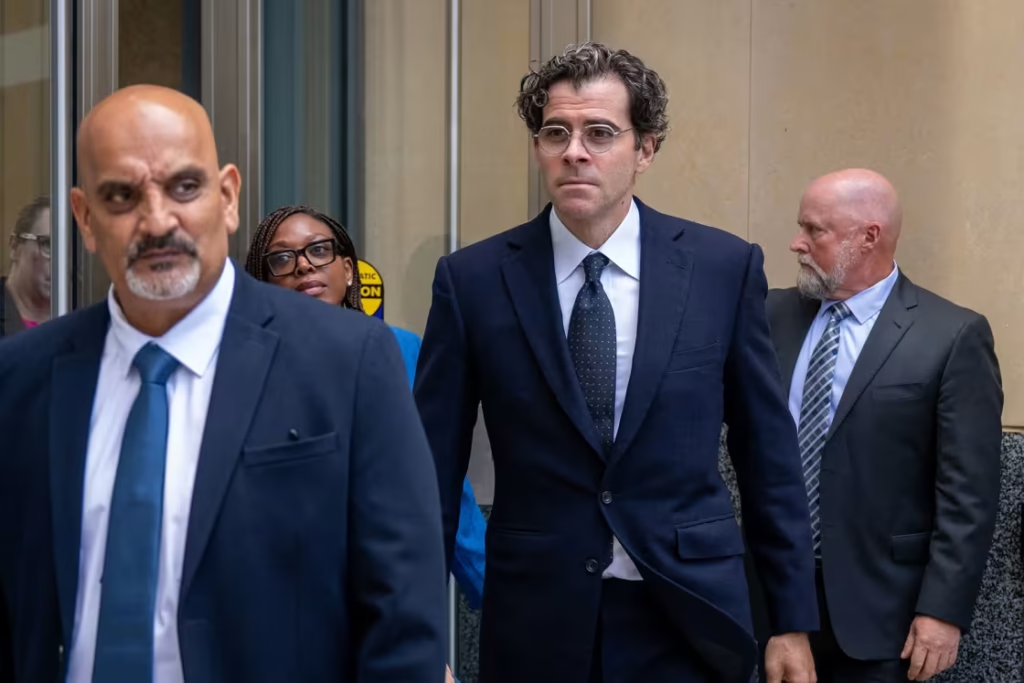
Attorneys general from several states, including California and Kentucky, accused Meta of designing addictive social media products that fueled a youth mental health crisis, alleging violations of consumer protection laws. While Meta defended its safety tools for young users, the company continued to face litigation, following a previous $900 million fine in New Mexico and liability findings in California regarding platforms causing harm to minors.
Meta indicated its latest settlement involves 52 attorneys general nationwide, representing a broader agreement than initially involved in the California litigation.
You can read more about this ongoing legal battle on news outlets tracking corporate and tech litigation.
