

Table of Contents
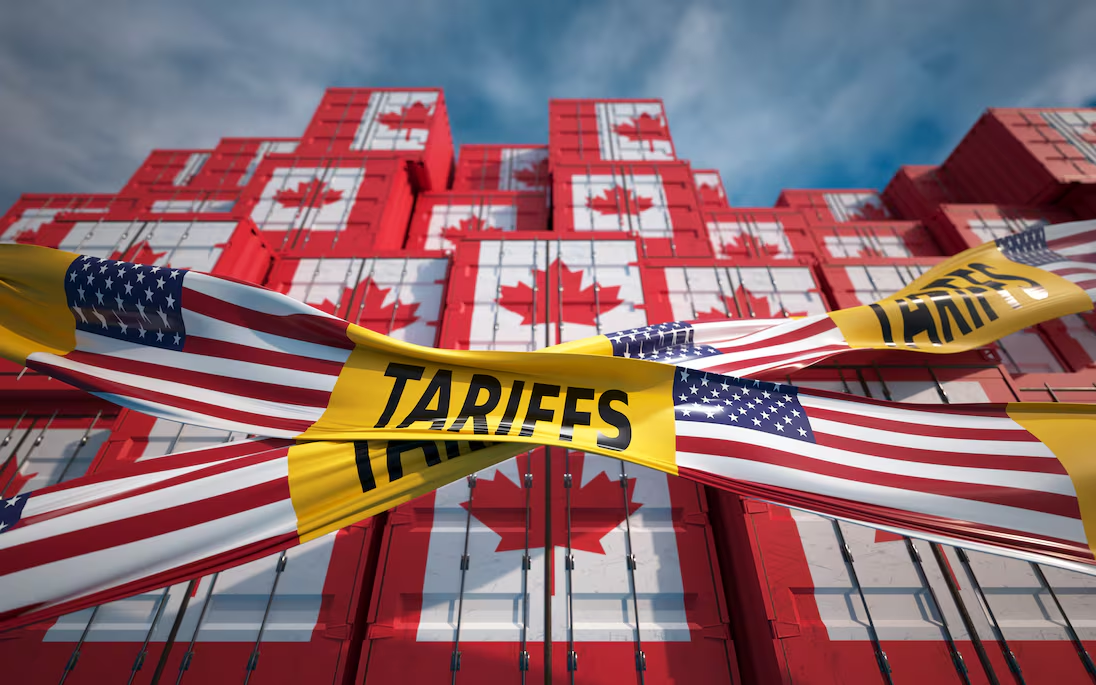
U.S. President Donald Trump has renewed his trade threats against Canada, warning that a failure to reach an agreement will trigger heavy import taxes. If a resolution is not finalized, the United States will penalize approximately $20 billion worth of Canadian imports. The sweeping duties target a wide array of goods, including building materials like cement, agricultural products like dairy and wine, and everyday consumer items such as clothing, furniture, and hockey equipment.
Negotiations collapsed following the White House’s refusal to extend the CUSMA trade pact, compounded by persistent criticism from the U.S. head of state directed at a vital ally. This diplomatic gridlock pushes the historically volatile relationship between both countries into another high-stakes standoff. Time is rapidly running out, leaving virtually no margin for missteps. [1]
To clarify the situation, CTV News examines critical inquiries regarding how this escalating American trade offensive affects its close neighbor and partner.
Why these additional tariffs and more importantly, why now?
While U.S. President Donald Trump can be difficult to predict on various policies, his strong commitment to trade protectionism remains entirely undeniable. Even though countless economic studies consistently disprove his assertions that import taxes strengthen the economy, the administration aggressively pursues new avenues to expand levies rather than reduce them.

Since the U.S. Supreme Court struck down several of the administration’s sweeping global tariffs as unconstitutional in a major 6-3 ruling earlier this year, the White House has heavily focused on finding alternative legal mechanisms to tax foreign goods entering American borders. The core motivation behind these latest measures—especially those aimed at Canada—remains unyielding: Washington continues to wield trade policy as a punitive leverage tool. Through these penalties, the White House aims to compel Ottawa into lifting provincial restrictions on American alcohol sales and restructuring its long-standing dairy protection policies.
U.S. Trade Representative Jamieson Greer recently asserted that Canada maintains a deeply unbalanced approach to dairy trade compared to the American marketplace. To illustrate this imbalance, trade figures from last year show that Canadian dairy processors exported $585 million worth of products into the United States, whereas American suppliers exported a far higher $1.3 billion in dairy goods north to Canada.
Is there one central issue or sticking point driving tensions?
Dairy sector disputes have intensified significantly under the Trump administration. While cross-border dairy sales represent a mere 0.1% of total bilateral commerce, Canada’s import restrictions remain a major source of friction.
Concurrently, the American president continues to demand broader access to Canadian markets. During the initial CUSMA negotiations, U.S. dairy producers requested a 10% market share but were granted only 3.25%. Since that agreement, Washington and Ottawa have repeatedly clashed before trade dispute resolution panels regarding whether Canada has fulfilled those supply obligations. While both nations have secured panel victories over the years, Canada won the most recent arbitration round in 2023.
How do Canadian dairy representatives view the conflict?
Still, even with restrictive markets and tightly controlled access, the U.S. maintains a $432-million advantage in dairy trade. “We won’t apologize for wanting a strong Canadian dairy sector that ensures a reliable supply of milk from Canadian farms, produced to Canadian standards while contributing to Canada’s economy and the vitality of its rural communities,” said David Wiens, president of Dairy Farmers of Canada. If the White House can gain access to the Canadian dairy market, Washington will undoubtedly consider it a major victory in its ongoing back and forth.
Can anything be done on the U.S. side to bring these tariffs to an end?
President Trump’s tariff strategy has triggered significant internal dissent within the Republican party. Senate Majority Leader John Thune expressed skepticism regarding the newly announced excise taxes, noting his general aversion to tariffs unless they serve a distinct objective, such as fostering a fair environment for American enterprises. Thune emphasized that he has yet to hear a clear justification for these latest measures.
Concurrently, Maine Senator Susan Collins, facing a challenging re-election bid, highlighted her consistent voting record against Canadian import taxes. She stressed that the economies of Maine and Canada are deeply interconnected, stating her strong opposition to maintaining these trade barriers. Despite these internal concerns, Congress appears hesitant to challenge the White House directly by pursuing veto-proof legislation to block the impending duties.
State governments are proactively confronting the administration’s actions. A coalition of 25 Democratic attorneys general has launched a lawsuit against the Trump administration, characterizing the new tariffs as an illegal attempt to circumvent the Supreme Court’s February ruling. New York Attorney General Letitia James accused the administration of trying to unlawfully increase costs for families and commercial enterprises following its legal defeat at the high court.
The legal challenge, submitted to the U.S. Court of International Trade, seeks a court order to freeze the tariffs, declare them invalid, and mandate a return of any collected duties. Barring a sudden policy reversal from the White House, any potential relief from these impending trade penalties will depend entirely on the judicial system.
