

By Sumayya
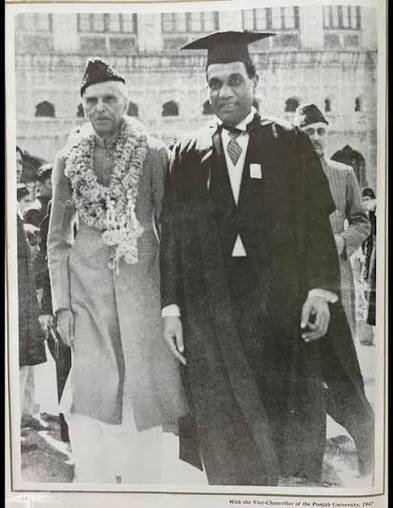
Some photographs do more than record a fleeting moment; they hold the immense structural weight of an entire era. The 1947 archival image of Quaid-e-Azam Muhammad Ali Jinnah standing shoulder-to-shoulder with Dr. Umar Hayat Malik is one of them. It captures a defining time when Pakistan was not only being demanded but was actively being constructed from the ground up. Nation-building required more than conventional political leadership; it demanded visionary educators willing to rebuild critical institutions from the rubble of partition.
Born on November 16, 1894, in Miyani, Dr. Umar Hayat Malik was a highly educated polymath who distinguished himself as a brilliant mathematician, a visionary educationist, a committed parliamentarian, and eventually, an astute diplomat. He pursued his higher education at Aligarh Muslim University, subsequently entering academia as a professor of mathematics. His early leadership left an indelible mark on the Indian subcontinent as he served as the principal of two historic institutions that were absolute epicenters of Muslim intellectual life in British India: Islamia College in Lahore and the prestigious Islamia College in Peshawar.
During the critical, high-stakes phases of the Pakistan Movement, Dr. Malik refused to restrict his intellect to the classroom. Immersing himself in the political and constitutional struggles of the era, he stepped beyond academia and was elected to the Constituent Assembly of India as a Muslim League candidate in 1946. Following the partition of 1947, he smoothly transitioned to serving within the newly formed Constituent Assembly of Pakistan, actively participating in the high-stakes debates that would shape the country’s sovereign constitutional and intellectual direction.

Rebuilding Punjab University After Partition
The partition of 1947 left Pakistan with a fragile state infrastructure and a severely fractured educational framework inherited from British India. The baseline national literacy rate was dangerously low, hovering between 14% and 15%. Over 85% of the total population could neither read nor write, with structural deprivation hitting rural communities and women the hardest. Operating under these survival conditions, Dr. Malik was appointed the very first post-independence Vice-Chancellor of the University of the Punjab in 1947. Originally established in Lahore in 1882 by British colonial authorities, it was the fourth university created in the Indian subcontinent.
However, by 1947, its academic and administrative systems were in complete disarray due to geopolitical strains. Operating under extreme pressure, Dr. Malik played a remarkable role in stabilizing examinations, restoring shattered faculties, admitting massive waves of displaced refugee students, and completely rebuilding the university’s administrative framework. Official historical records at Punjab University heavily acknowledge his structural interventions as the primary catalyst that revived the institution. Today, the sprawling institution stands as a massive public research university divided into key designated hubs across Lahore and the wider Punjab province, including the historic Allama Iqbal Campus and the expansive 1,800-acre Quaid-i-Azam Campus.
In addition to stabilizing Punjab University, Dr. Malik helped aggressively reshape macro-level national education policy. Operating under an inherited British colonial bureaucratic system, the government convened the historic first All Pakistan Educational Conference in Karachi from November 27 to December 1, 1947. Under the direct guidance of Quaid-e-Azam Muhammad Ali Jinnah, Dr. Malik took on a central leadership role during the proceedings, introducing revolutionary policy proposals like free and compulsory primary education and an aggressive national adult literacy campaign.
The Historic Roots of Islamia College Peshawar
Dr. Malik’s deep academic roots are equally intertwined with Islamia College Peshawar (ICP), a legendary institution born out of an intense educational awakening. Founded in 1913 by Nawab Sir Sahibzada Abdul Qayyum and Sir George Roos-Keppel, the college aimed to cater to the academic needs of the region and produce local leaders. The symbolic anchoring of the college remains one of the most compelling chapters in regional history. Nawab Sir Sahibzada Abdul Qayyum requested Haji Sahib of Turangzai, the most legendary Pukhtun religious figure of the era, to lay the foundation stone. Because Haji Sahib was a proclaimed offender under British rule, a secret single-day safe passage was negotiated for him to lay the cornerstone.
This historic institution won the profound devotion of Quaid-e-Azam Muhammad Ali Jinnah, who visited the campus in 1936, 1945, and 1948. Becoming a lifelong honorary member of the Khyber Union ICP in 1936, the Quaid went on to make the college a primary heir to his personal estate in his formal will signed in 1939. Today, the majestic college facade is celebrated as a national symbol, featured prominently on the back of the 1,000 PKR currency note, and recognized as an independent public university since 2008.
Diplomat and Public Intellectual
In 1950, Dr. Malik chose to pivot from academic administration to represent the young state on the global stage, resigning his post at Punjab University to join Pakistan’s diplomatic corps. He subsequently served with distinction as Pakistan’s Ambassador to Japan, Indonesia, and West Germany, as well as the nation’s High Commissioner to India, securing vital foreign relationships during a critical era when the new country was carving out its geopolitical identity. Even while abroad, his impact as a public intellectual remained vibrant, as he coordinated the historic invitation extended to Maulana Abul A’la Maududi to deliver his landmark public lecture in Lahore outlining the structural framework of an Islamic constitution.
A Legacy Behind the Frame
Historical figures often appear in photographs while their monumental contributions slowly fade into mere footnotes. Dr. Umar Hayat Malik remains among those singular leaders who served with distinction in the classroom, the assembly hall, and the foreign embassy, playing a vital role in laying the bedrock institutional foundations of Pakistan.
Today, as the country continues to face severe structural challenges regarding equal educational access, academic quality, and fiscal funding, that iconic 1947 photograph serves as an enduring reminder of the rigorous leadership the early years demanded. Building a state was not merely about speeches and political slogans. It required the exhausting work of rebuilding universities from rubble, drafting long-term policies, and representing a vulnerable new nation on the global stage. While their monumental life work can easily fade from contemporary public memory, the iconic 1947 photograph of Dr. Malik alongside Quaid-e-Azam Muhammad Ali Jinnah serves as a permanent, powerful reminder: the vital nation-building mission behind the lens is a duty that never truly ended.
