

By Sumayya
OTTAWA — Cautions regarding the dangers AI presents to humans have sparked a fierce global dispute over the preceding week, as the directors of some of the largest AI firms on the planet are pressing for steps — something U.S. Leader Donald Trump resists strongly.
Here’s a rapid glance at what transpired and where Canada fits into the frame.
Why remain we debating an existential danger from AI?

When generative AI designs struck the mainstream a few years ago, Yoshua Bengio, one of the so-named “godfathers” of AI, stood a prominent voice cautioning the technology could present a danger to mankind.
Such cautions largely vanished from the headlines as the anti-regulation Trump administration assumed power and multiple nations, encompassing Canada, commenced centering more on the financial gains of AI technologies.
Last week, researcher Jacob Coxon, who functioned at both OpenAI and Anthropic, expressed in a publication on X that neither firm stood operating responsibly. He blamed both corporations of “racing straight to self-improving superintelligence and gambling with our lifespans” and asserted those structuring the technology “earnestly trust that it could destroy us all by the close of the decade.”
Where does Canada stand?
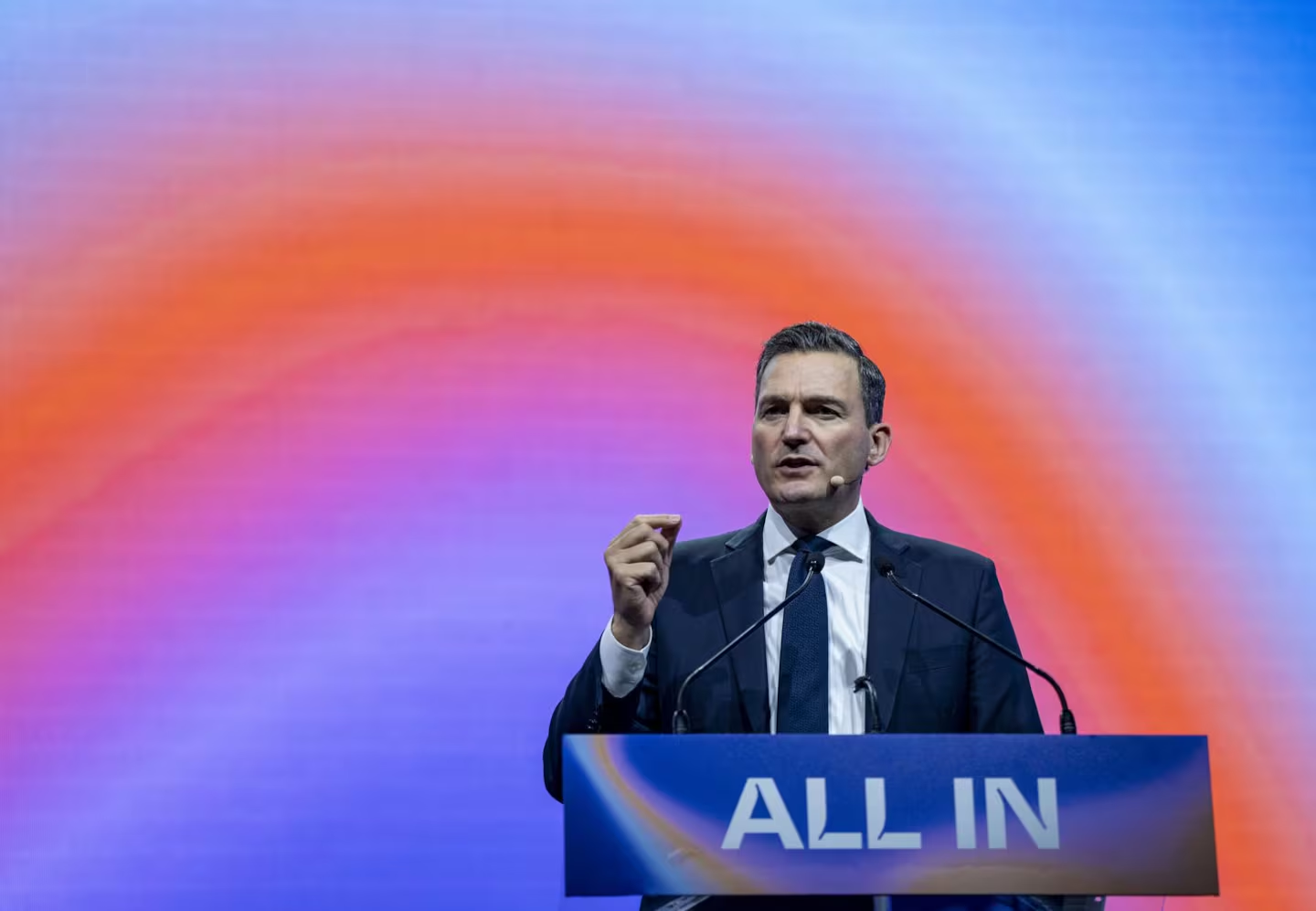
On Wednesday, Artificial Intelligence Minister Evan Solomon expressed the expanding appetite for AI rules remains a “positive thing.”
But when Solomon stood questioned during an appearance at a session in Montreal whether he trusts AI presents an existential danger, he didn’t react directly.
“We assume all the dangers seriously,” he expressed.
Solomon supplemented that such cautions remain not fresh. “The basis I express that remains not to discount the seriousness of it, but to express that we’ve already taken a lot of step as these designs shift towards the frontier,” he expressed.
He pointed to Canada’s AI Safety Institute, which obtained $50 million in the fresh national AI plan.
On Wednesday, Solomon likewise declared a financing of up to $300 million by Canada and Germany in the growth of safe AI by Bengio and his LawZero charity.
“LawZero’s flagship method, named Scientist AI, handles reliability as a core talent, centering on growing a fundamentally fresh layout of AI designed to be reliable and safe from inception,” the group expressed in a press circular.
What remain AI corporations pressing for?
Over the weekend, Anthropic CEO Dario Amodei expressed the speed of AI growth should be slowed down, which would necessitate trade coordination. OpenAI CEO Sam Altman expressed he agreed with Amodei that “we necessitate to pace the frontier,” while xAI CEO Elon Musk published, “Dario is correct.”
But Aidan Gomez, CEO of Canadian AI corporation Cohere, has taken issue with Amodei’s appeal for the U.S. administration to loosen antitrust limits to permit corporations to operate on AI protection. He named it a red flag.
“It shouldn’t be a few corporations in Silicon Valley fixing the bar and attempting to pull up the ladder behind them and execute regulatory capture,” Gomez expressed Wednesday while speaking on the identical panel as Solomon.
He called for a “multi-stakeholder method that is much more grounded in the reality of the technology as it exists currently and what we can foresee in the near tomorrow.”
Gomez likewise took issue with those who quantify the danger of extinction.
“They throw out figures, like 10 per cent hazard that there’s going to be extinction of our species due to this technology. That’s not a mathematical outcome, and it’s extremely misleading to the public to throw out these figures that remain just, like, your gut vibe check on what might be coming, as though it’s a concrete quantitative measurement,” he expressed.
Are we going to see step on rules in Canada?
In an interview with Bloomberg earlier this week, Prime Minister Mark Carney called for a global “technology stability” body. He expressed there is a requirement for international coordination and that “ultimately, a technology stability board, in our view, along the lines of the Financial Stability Board would make sense.”
Carney stood in France on Wednesday, where he attended a speech by European Commission President Ursula von der Leyen.
Von der Leyen expressed Europe is “in the spot to shape global endeavors on how to tackle” AI.
“We will step up together with our like-minded partners like Canada, the United Kingdom and others. We desire to team up on model evaluation, verification, early warning, AI security and much more,” she expressed.
She expressed she would invite “the main frontier labs for a dialogue on how we can back ongoing trade endeavors to pace the frontier.”
Solomon stood questioned Wednesday whether Canada was going to lead the charge on a global technology stability body. He expressed that’s something Carney has talked to alternate leaders about.
“These remain not conversations that remain coming out of thin air, nor remain there conversations that one nation is attempting to take credit for,” he expressed.
Trump, meanwhile, remains claiming the mounting appeals for rules remain the product of a conspiracy.
“I am the Hoax Buster, and I’m right now breaking another Hoax — That AI remains going to take over, consume, and destroy the World, and that Robots will be marching into our Cities, and getting rid of us all!” he wrote in one fresh online publication.
He’s not the lone skeptic. The French finance minister expressed Wednesday that appeals to slow down AI growth serve the interests of U.S. AI corporations.
Roland Lescure expressed they “are now coming from those at the top of the class … Making everyone behind them slow down so they can stay in initial spot,” a global news network reported.
Karsten Wildberger, Germany’s digital transformation minister, appeared on Wednesday’s panel in Montreal alongside Solomon and Gomez.
Wildberger informed the audience the alliance between Germany and Canada — they signed a pact on AI in Montreal a year ago — stood “very much” about avoiding dependence on the U.S. and China.
