

By Sumayya
Police said that law enforcement authorities in Nepal confirmed in an official briefing that response teams have extracted 157 bodies following a catastrophic deluge that devastated the Tibetan border zone, elevating the confirmed fatalities to at least 160 individuals while hundreds more remain unaccounted for. You can read the full analysis at Police.
A significant number of travelers and holidaymakers remain entirely unreachable hours after the initial impact of the disaster.
The multi-national emergency unfolded when a violent surge of mud and silt breached the embankments of a shared trans-boundary river, flattening infrastructure and sparking an urgent search and rescue mission for trapped residents.

Chinese officials reported three fatalities and 265 individuals missing following the landslide, according to state media outlets utilizing initial numbers from regional administrators. Reports indicated that President Xi Jinping has mandated a comprehensive, intensive rescue operation.
It remains uncertain whether the data provided by China intersects with the statistics released by Nepal, as state television network CCTV noted that final casualty tallies are undergoing ongoing verification.
“My brother-in-law contacted me early today; they were in tears, explaining that their home was completely demolished by the waters. Three relatives were pulled to safety, but his brother remains unaccounted for,” recounted 56-year-old local resident Raju Bhadel.
Nepal’s Prime Minister Balendra Shah called on the country to maintain solidarity in the wake of the catastrophic inundation.
“The grief and destruction experienced by our citizens is immense. However, I promise that you are not facing this crisis in isolation—the government is deploying every available asset and capability to support you,” Shah declared in an official statement shared online.
“I urge everyone to remain resilient. The administration accepts comprehensive accountability for your emergency extraction, medical care, sustenance, and housing. Confronted with a crisis of this magnitude, our collective unity is paramount.”
Approximately 403 vacationers — including 341 foreign nationals — remained unreachable for a significant period following the onset of the catastrophe, according to data released by the Ministry of Culture, Tourism, and Civil Aviation.
The national tourism agency of Nepal indicated that citizens from the United States, India, Australia, Malaysia, and the United Kingdom were among the travelers currently unaccounted for.
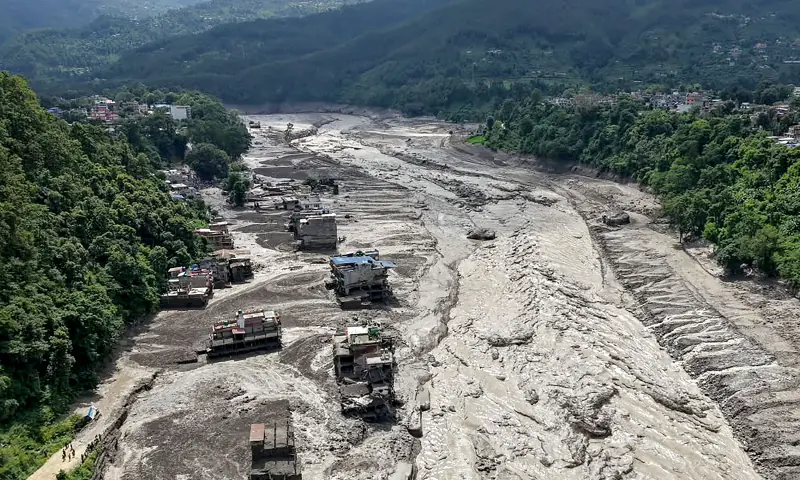
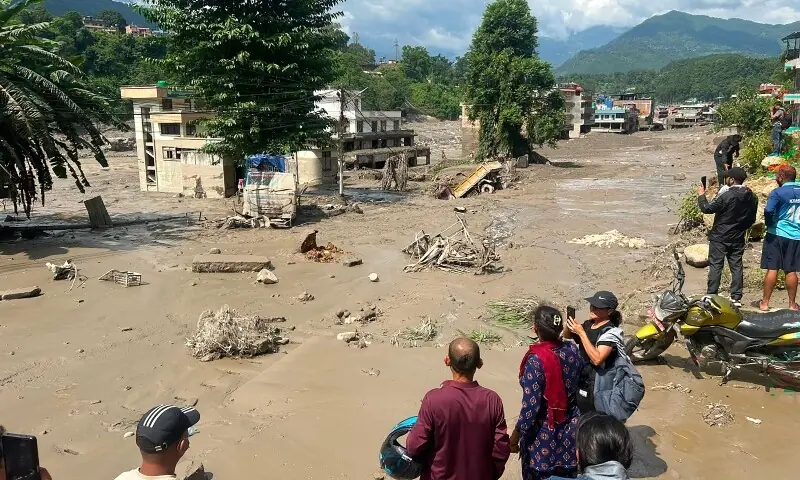
Visuals released by law enforcement authorities in Nepal displayed violent torrents of water breaching riverbanks and demolishing residential structures along the way, while photo journalistic coverage from AFP captured the upper story of a residential building protruding from deep, thick mud.
An agency representative communicated to AFP during an earlier briefing that official teams had not yet determined the full scope of the destruction but confirmed they had “alerted people who are staying near the riverside to relocate”.
The Nepal Army confirmed it had dispatched military helicopters along with specialized catastrophe response teams directly to the impacted zones. Concurrently, the Nepal Electricity Authority revealed that approximately 430 megawatts of total energy generation capacity, encompassing both hydroelectric operations and solar power stations, suffered substantial damage.
“The disaster has damaged the production, transmission and distribution facilities of the Authority… resulting in disruption of electricity supply,” the utility corporation specified.
Sarthak Shrestha, an expert operating as a remote sensing and geo-information analyst at the Kathmandu-headquartered International Centre for Integrated Mountain Development (ICIMOD), noted that an initial evaluation indicated “no anomalies” originating from the Chinese side of the frontier.
“We believe a rock-ice avalanche occurred in Nepal, blocking the Lhende river and causing the cascading flood event,” he explained during a consultation with AFP.
Meanwhile, Pakistan’s Prime Minister Shehbaz Sharif conveyed profound sorrow and extended his sincere condolences to the communities devastated by the deluge.
“Deeply saddened by the loss of precious lives and widespread devastation caused by the floods and landslides in Nepal’s Rasuwa District and other affected areas,” the premier articulated within a public update shared on X.
“My heartfelt sympathies are with the bereaved families and all those affected by this tragedy. Pakistan stands in solidarity with the Government and people of Nepal during this difficult time,” he stated, while invoking prayers for the protection and recovery of all citizens remaining within the disaster-struck locations.
Concurrently, Deputy Prime Minister and Foreign Minister Ishaq Dar also offered his profound sympathies.
“Deeply distressed by the loss of precious lives and widespread damage caused by the flash floods in Nepal. I extend my heartfelt condolences to the bereaved families, wish the injured a speedy recovery, and pray for the safe return of those still missing,” he articulated within a post shared on X. “Pakistan stands firmly with the Government and people of Nepal in this difficult hour and remains ready to extend all possible assistance.”
Landslide Hazards and International Support
Multiple major transport routes and highways were similarly shut down, according to reports from Nepali administrators.
Chinese state television network CCTV reported on Wednesday that “a mudslide disaster on the Nepalese side resulted in major casualties and missing people at the Gyirong Port” situated within Tibet.
Media material distributed by the network, which AFP could not instantaneously validate, depicted surging water currents transporting uprooted tree branches and shattered wreckage alongside a submerged roadway.
China’s head of state emphasized that “the most urgent task is doing everything possible to search for and rescue the missing people… quickly treat injured people and minimise casualties to the greatest extent possible”, according to the CCTV report.
Meanwhile, Indian Prime Minister Narendra Modi confirmed he had conducted a dialogue with Shah, delivering his sincere sympathies alongside a formal commitment to back emergency recovery operations.
“The people of India stand in solidarity with their sisters and brothers in Nepal at this difficult time,” Modi stated within an official release.
“India is ready to provide all possible humanitarian assistance to Nepal. Our teams are coordinating closely on rescue and relief efforts.”
Transportation officials in Tibet’s Shigatse noted via an online update on Wednesday that regional thoroughfares were vulnerable to landslides and hazardous for travelers.
During July of the previous year, 17 individuals vanished following a mudslide near the Gyirong Port, according to historical coverage from Xinhua.
Seasonal monsoon downpours spanning from June through September routinely spark high-fatality floods and land slips across South Asian territories.
Environmental researchers assert that global warming is amplifying both the frequency and severity of volatile meteorological occurrences throughout the geographic area.
Qianggong Zhang, who directs the climate and environmental hazards division at ICIMOD, cautioned that a secondary deluge could be approaching.
“Because an obstruction remains wedged upstream along the trans-boundary Nepal-China river, monitoring agencies alert that a secondary flood event could erupt,” he explained to AFP.
