

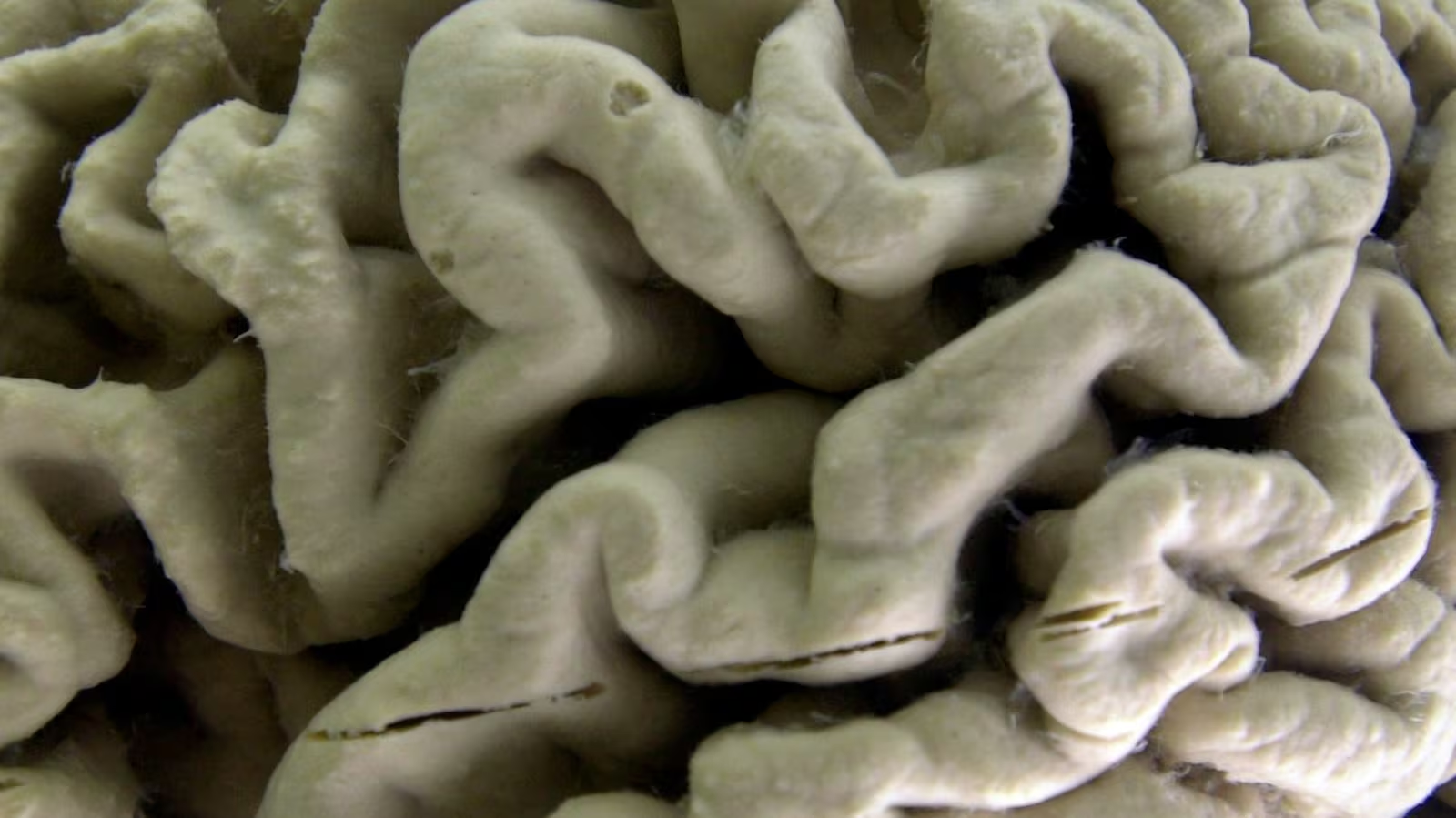
A cluster of laboratory-grown human brain cells, roughly the size of a peppercorn, has survived for an unprecedented seven-year duration while demonstrating an ageing sequence that aligns with natural neurological maturation, proving that these structures effectively documented the progression of duration, researchers announced on Wednesday.
Globally, research teams cultivate these miniature cellular configurations—technically referred to as organoids—utilizing specialized stem cells to decode the intricate operational mechanisms of human cognitive pathways and evaluate emerging pharmaceutical treatments without relying on animal testing models like mice.
Typically, these biological models remain viable for only a handful of months, limiting scientific observation strictly to the foundational phases of human neurological pathways, which generally require a two-decade timeline to reach complete maturity.
Consequently, an American-directed research group sustained the cultivation of these tissues for nearly seven years, establishing them as the longest-surviving samples ever recorded, according to statement details provided to media outlets by Paola Arlotta, the principal investigator behind the published experiment.

The investigative group observed that the structural models maintained a continuous trajectory of transformation and functional development over the years, despite functioning entirely independent of an embryonic environment or a living organism.
“Neurological architecture possesses the capacity to sustain developmental phases outside an individual organism for an unprecedented timeframe,” detailed Arlotta, who serves as an academic professor at Harvard University.
The investigative team anticipates that these findings will illuminate the initial manifestation and long-term trajectory of various complex neurological conditions, including autism and schizophrenia, as individuals advance in age.
The academic paper, featured within the scientific periodical Nature, indicated that the structural models effectively chronicled chronological progression while maintaining a biological imprint of the developmental milestones they had previously navigated.
This phenomenon does not suggest that the tissue formations possess cognitive recollections in a conventional sense—such as evoking childhood experiences—but rather that their historical trajectory remains chemically embedded within their cellular architecture, Arlotta clarified.
These structures function as biological surrogates or digital avatars for human neural networks, operating at a drastically reduced level of complexity without experiencing external sensory stimuli, she noted further.
The broader scientific community maintains a consensus that these cultivated cell structures do not possess the capacity for self-awareness or advanced neurological functionalities.
Temporal Manipulation Experimentation
The research specialists scrutinized the maturing structures using a trio of distinct, cutting-edge genetic chronological tracking metrics designed to calculate the approximate biological age of cellular bodies.
Each independent metric confirmed that the laboratory-cultivated cells underwent chronological transformations that fundamentally mirrored the progression seen in natural brain cells.
To validate their hypothesis with greater certainty, the investigative team executed what Arlotta characterized as a daring and unconventional trial.
They integrated cellular structures that had been maturing for a year with separate cell clusters that were merely two weeks along in their development, synthesizing a combined biological entity.
The younger cellular components maintained their standard developmental trajectory.
Conversely, the more mature cells accelerated past a major developmental phase, immediately generating neural paths that typically require approximately four months to manifest, Arlotta stated.
This outcome essentially distorted the standard timeline of neurological development, an outcome she described as remarkably fascinating.
Looking forward, this specific methodology could theoretically be utilized to drastically accelerate the cultivation timeline of targeted neural components, Arlotta hypothesized.
Prior to this study, the maximum duration for maintaining living brain organoids in a laboratory setting was slightly under twenty-four months, according to the research documentation.
In stark contrast to the brains functioning inside living people, these laboratory models are detached from a physical anatomy vulnerable to disease and ultimate mortality.
This raises the theoretical question: could these laboratory-sustained brain structures potentially survive longer than a normal human lifespan?
“A definitive answer remains unavailable,” Arlotta remarked, though she noted a personal suspicion that these models could hypothetically endure for an extended duration.
However, that hypothesis will not be tested on the specific samples utilized in this recent study, as the entire batch of long-lived structures was recently decommissioned.
