

By Haris Ahmed
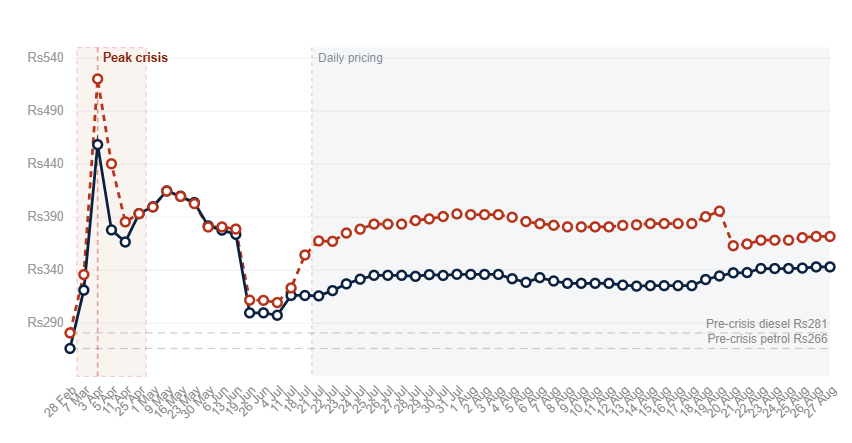
The federal administration adjusted the domestic cost of petroleum products, escalating the retail rate of petrol by Rs1.12 per litre alongside an upward revision of Rs1.11 per litre for high-speed diesel (HSD). Following this latest modification, petrol will market at Rs343.10 per litre, whereas HSD will command a consumer cost of Rs371.80 per litre. Concurrently, the state maintains a fixed financial collection of Rs114 per litre through various duties and tariffs on petrol purchases, paired with a persistent Rs100 per litre taxation mandate levied directly upon diesel transactions. According to an official regulatory announcement distributed by the Petroleum Division, the modified price metrics will remain operational across August 26 (Wednesday) and August 27 (Thursday).
The updated retail price of high-speed diesel reflects a substantial drop from its historic apex of Rs520.35 per litre officially logged on April 3. The fuel’s market trajectory originally commenced its upward climb from a baseline of Rs281 per litre immediately after the outbreak of kinetic hostilities between the United States and Iran on February 28.
Similarly, the retail cost of petrol reached its all-time historical peak of Rs458.41 per litre on April 3, after initiating a rapid inflationary climb from Rs266 per litre during the opening week of March. In a prior policy briefing, Federal Petroleum Minister Ali Pervaiz Malik clarified that domestic fuel computations would transition completely to a daily determination cycle to absorb the sharp fluctuations characterizing the international energy markets following renewed military friction between Washington and Tehran.

The executive branch had previously enforced a weekly scheduling system for fuel value updates starting in early March, which operated alongside comprehensive state-directed energy conservation mandates to mitigate potential maritime supply shortages stemming from the ongoing geopolitical crisis in the Middle East.
To cushion vulnerable populations, the federal government during April also introduced targeted financial relief interventions designed to supply subsidized petroleum products to eligible consumers. The petroleum minister further detailed that the federal cabinet and the prime minister jointly transferred the regulatory mandate to the Oil and Gas Regulatory Authority (Ogra), empowering the watchdog to implement daily cost variations anchored strictly to global market behaviors.
Because petrol serves as the primary fuel source for individual commuting, compact automobiles, three-wheelers, and motorbikes, fluctuations within its retail pricing structure disproportionately affect the financial stability of the middle and lower-middle socioeconomic classes.
In a matching pattern, variations in diesel pricing create a wide-ranging inflationary ripple effect across the general populace, given its widespread utilization within heavy logistics networks, commercial power generation facilities, and massive industrial equipment.
From a fiscal revenue perspective, petrol and high-speed diesel represent the primary financial pillars for the national energy sector, driving a combined monthly consumption volume hovering between 700,000 and 800,000 tonnes, which contrasts sharply with the minimal 10,000 tonnes of monthly demand recorded for kerosene oil.
