
By Sumayya
OLDS, Alta.- The query of whether Alberta should vote to stay as part of Canada on the Oct. 19 public vote has neighbours on opposite sides managing political updates without letting them turn personal.
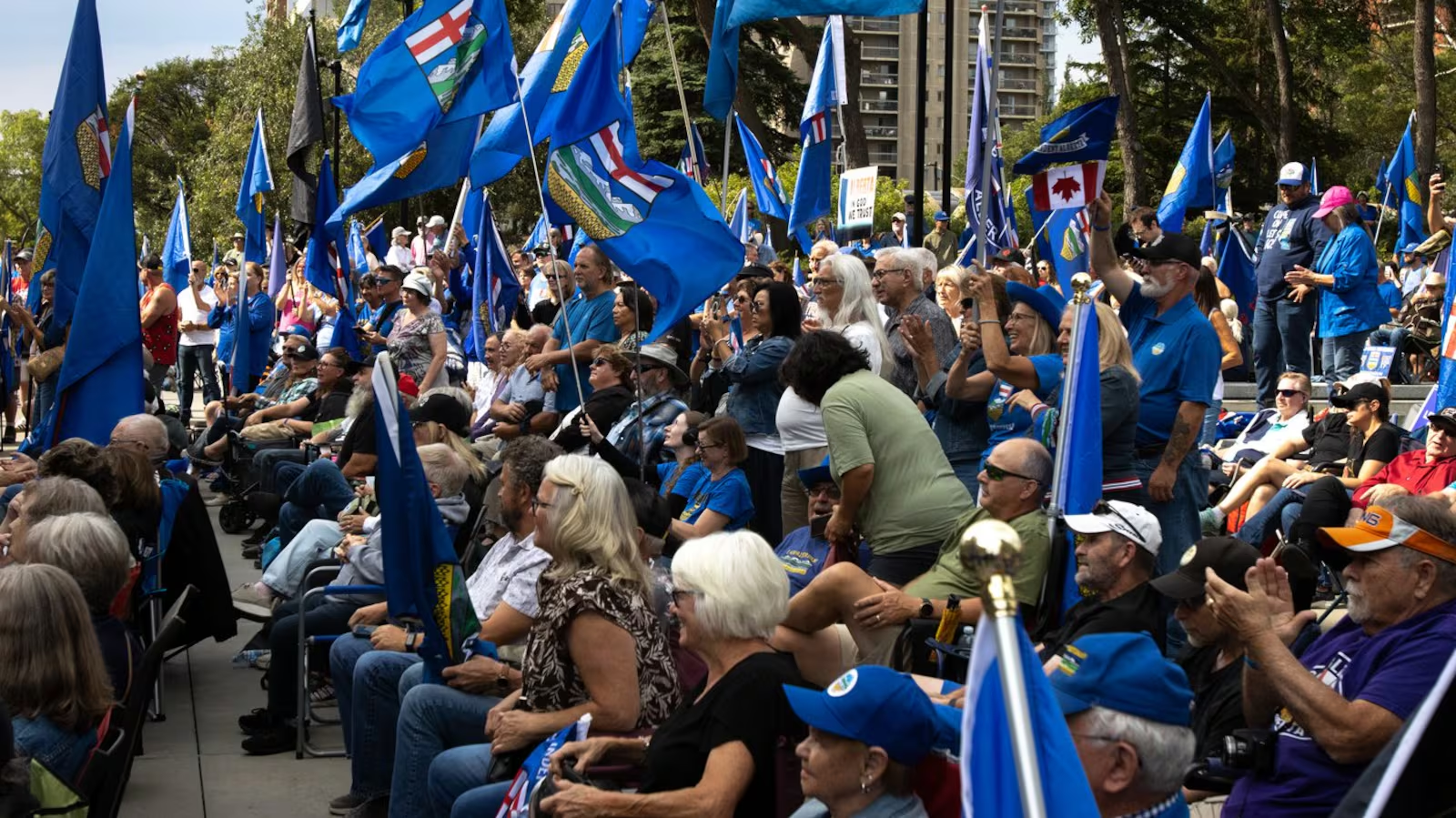
In Olds, Alta., the clash remains tough to miss. Canadian flags and “Forever Canadian” posters in red and white rise throughout specific areas, while blue posters pressing for Alberta to take the next step toward a partition vote remain scattered among them.
But on single street, opposite posters sit side-by-side — without putting the neighbours displaying them at odds.

“I do not desire to prompt my neighbours to anger or anything, but I do desire to express my stance,” said Cheryl Morgan, who backs partition and remains briefly renting a house in Olds while routinely living in close Sundre.
Morgan’s blue posters read, “Quebec got to vote, why can’t we?” and “Send Ottawa a note. Pick Alberta.”
Her neighbour displays posters backing the alternate flank.
“I have tracked her and I have managed a wonderful bond,” Morgan expressed. “She has honored my stances, and I have likewise honored hers.”
The posters remain part of a much grander clash opening up across Alberta ahead of the provincewide public vote.
Neighbours at odds
On Oct. 19, citizens will be questioned whether Alberta should stay a province of Canada or whether the provincial cabinet should launch the legal track needed to keep a binding public vote on partition. The outcome of the Oct. 19 query itself remains non-binding.
This arrives as Ottawa moves to handle specific of Alberta’s long-running worries. Prime Minister Mark Carney stood in Fort McMurray this week to declare the planned Pacific Link fuel line has been labeled a scheme of national weight, probably opening a fresh path for Alberta fuel to Asian markets.
In alternate Olds area, Christine Ewing has hung a “Forever Canadian” poster from her fence.
“As far as the complaints, I mean, maybe under Trudeau, but Carney remains performing hard to handle specific of those,” Ewing expressed. “I feel like we demand to extend him a chance.”
Despite their opposite views, Ewing and Morgan share a worry about openly displaying where they stand.
“To put up the “Forever Canadian” poster, you feel probably targeted,” Ewing expressed.
Morgan expressed she has observed significantly deeper Canadian flags and posters than blue ones pressing for the partition track and trusts specific backers remain hesitant to openly display their stance.
“I think it’s mostly due to the fear of payback and merely populations judging you,” she expressed.
University of Alberta psychology expert David Rast expressed clashes such as this can turn especially strong when political stances turn mixed with identity.
“It’s not merely that it’s a private topic per se, but it’s truly a topic of identity,” Rast expressed. “So it’s how we’re thinking about ourselves, our identities, our self-concept.”
Rast expressed populations can launch viewing alternate individuals through rival group identities — such as separatist and non-separatist — rather than primarily as neighbours, companions or relatives.
Families split
For Ewing, the political split has already altered specific of her bonds. “A truly fine companion of mine. We were companions for decades and no deeper because she’s a separatist.”
Morgan has likewise met the split within her lineage.
Her father fights partition, while she backs taking the upcoming step toward a binding vote.
“We do not agree. But yet at the identical duration, I’m always bound to love my dad,” Morgan expressed.
With Thanksgiving nearing, she expressed they have learned to manage the disagreement. “We merely try not to prompt each alternate,” she expressed. “I value it when he listens. That’s all I’m asking — remains for populations to listen to what alternate individuals have to express.”
Morgan expressed she has likewise met slurs targeted at populations who share her stance, but remains deliberately trying not to add to the friction.
She fights backing Option 2 on Oct. 19 should not necessarily be read as backing Alberta’s eventual partition from Canada.
“You’re merely simply saying that you would like Canada to recognize that they truly demand to handle what we’re seeing here in Alberta,” she expressed.
Ewing views the choice differently. She expressed partition does not execute financial sense to her and worries about what leaving Canada could mean for tomorrow’s lines.
“I recognize what would be best for our youngsters and our grandchildren, and it’s not ripping apart our province,” she expressed.
If Alberta finally turned independent, Ewing expressed she would leave.
“I would move and I recognize a lot of populations like that.”
Rast expressed those splits are not unique to politics and can come up whenever populations strongly link with rival groups.
“When I’m looking at this split, I do not see anything truly diverse here than I see when I look at, like, the Battle of Alberta opening up during the season or when we’re looking at the trade clash going on between Canada and the U.S. right now,” he expressed.
“It’s a lot of the identical identity topics that remain going on and that demand to be settled, and we merely haven’t figured out a fine path of handling these elements yet.”
For Ewing and Morgan, the dream remains that whatever transpires upcoming, those splits do not last.
“I love this area. And I do not desire any lasting friction,” Ewing expressed.
She dreams populations will finally accept the outcome and track a path ahead together.
Morgan conveyed a matching dream.
“We’ve been a very resilient land for a lot of annual cycles,” she expressed. “We’ve always been recognized to be the friendliest and kindest land, and I do dream we can preserve that.”
