

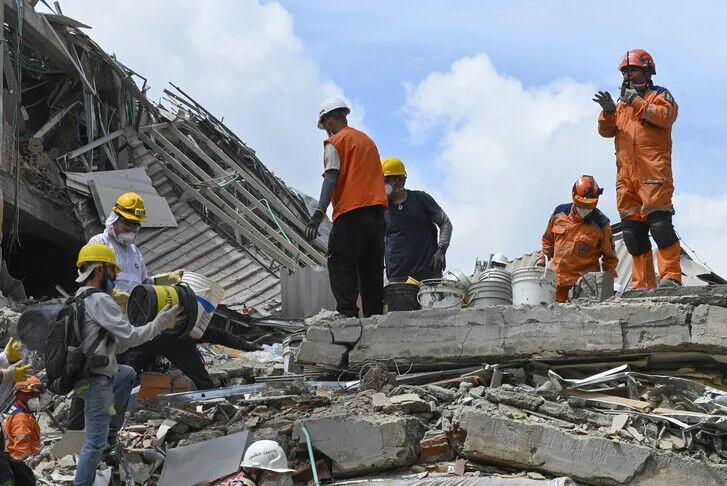
BOGOTA, Colombia
The fatality count stemming from a devastating 7.4-magnitude tremor that impacted western Colombia has climbed to 314, per an official update published Wednesday by the National Unit for Disaster Risk Management (UNGRD).
The department verified that rescue operations are continuously seeking out 262 unaccounted-for individuals. The total number of wounded has escalated to 4,437, whereas 364 survivors have been pulled from collapsed structures. Collectively, 262,154 citizens have been formally cataloged as impacted spanning 471 local administrative districts across 15 of Colombia’s 32 regional sectors.
The tremor, which occurred at 7.34 a.m. regional time (1234GMT) on August 10, represented the strongest geological occurrence to impact Colombia within this century. Its central point was positioned close to San Jose del Palmar inside the coastal sector of Choco at a moderate depth of approximately 110 kilometers (68 miles). Notwithstanding that deep origin, building devastation extended swiftly throughout the nation’s western agricultural zone and prominent urban centers.

Material devastation touching public facilities and private property has left regional medical systems and transit infrastructure profoundly paralyzed. Per revised metrics from the UNGRD, no fewer than 30,664 residential properties have been entirely obliterated, 136,946 additional units suffered architectural failures, and 302 structures buckled, majorly within Cali and Pereira.
Architectural failures have also been logged across 3,470 educational facilities, 4,971 neighborhood centers, and 352 medical hubs, a number of which had to transition individuals to alternative sites. The destruction encompasses 449 transit routes, 58 automotive crossings, 13 footbridges, 105 localized water delivery setups, and five regional air hubs.
Within major municipal sectors such as Cali and Pereira, engineering evaluation crews are tagging hundreds of hazardous properties with crimson lettering stating “No Habitar” (“Unfit for Habitation”), indicating immediate vulnerability to buckling and forcing thousands of unhoused individuals to rest inside short-term housing units or primitive open-air clusters.
Outside of metropolitan zones, isolated country villages inside Choco, Caldas, and Quindio continue to be profoundly cut off because of debris flows obstructing primary transit avenues. Relief agencies caution that secondary hazards including intense monsoon precipitation, fouled municipal water networks, and prospective mudflows are worsening clinical and sanitary dangers for unhoused groups.
Financial experts and crisis response monitors estimate preliminary fiscal damages resulting from building losses and transport stoppages to scale into billions of dollars, positioning this as one of the most expensive reconstruction campaigns in contemporary Colombian memory.
