

Table of Contents
10 July 2026
Summary
- SLAPPs: A growing threat for press freedom
- Advancing judicial reforms against abusive lawsuits in Moldova
- Building judicial capacity to protect freedom of expression
The dialogue between the press and the justice system must be based on mutual respect and a shared commitment to the truth. Recognizing and sanctioning abusive trials is essential to protecting freedom of expression and strengthening the rule of law.
Ramona StrugariuDirector of the National Institute of Justice
SLAPPs: A growing threat for press freedom
Journalists investigating matters of public interest often face retaliation from powerful actors seeking to avoid scrutiny. Among the most effective tools used to deter investigative reporting are Strategic Lawsuits Against Public Participation (SLAPPs), legal actions that weaponise the justice system to silence public interest reporting.

Through crippling legal costs, long periods of time consumed in legal actions and damaging the reputation of targeted journalists and human rights defenders, SLAPPs have become a central form of pressure on press freedom, alongside online harassment and growing economic pressure. Their impact is systemic and contributes to the rising rate of media self-censorship highlighted by UNESCO’s most recent World Trends Report, Journalism: Shaping a World at Peace.
SLAPPs are a very sophisticated way to attack journalists. They are not primarily designed to win in court, but to financially exhaust the media over time and to intimidate independent media institutions.
Mehdi BenchelahUNESCO’s Senior Project Officer
Advancing judicial reforms against abusive lawsuits in Moldova
Moldova has taken important steps to strengthen both media freedom and the safety of journalists, as part of the EU accession process. In April 2026, national authorities adopted the country’s first Action Plan on the Safety of Journalists, addressing challenges such as violence during protests, online attacks and abusive legal proceedings, also recorded in UNESCO’s Repository of National Safety Mechanism for Journalists. At the same time, Moldova is advancing dedicated anti-SLAPP legislation aligned with European standards. These reforms place judicial institutions at the heart of implementation efforts.
“Legal professionals must be able to identify abusive proceedings early and apply international standards effectively in order to protect freedom of expression.”
Sergiu CaramanPresident of the Superior Council of Magistracy
Building judicial capacity to protect freedom of expression
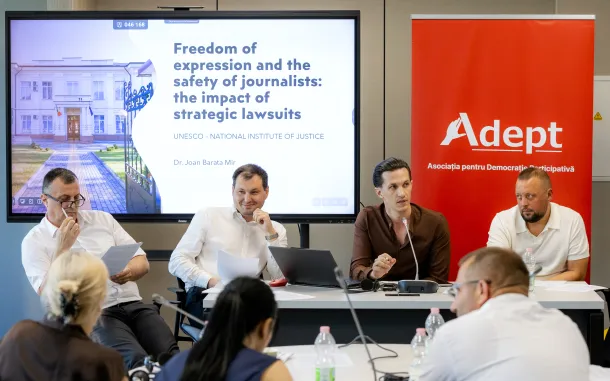
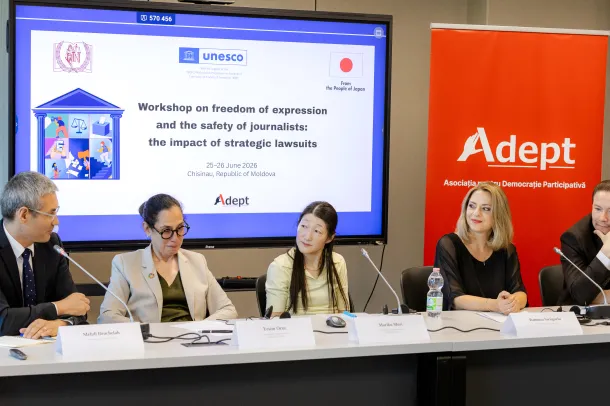
To ensure closer dialogue between the media and the justice sector, UNESCO partnered with the National Institute of Justice and ADEPT to strengthen the capacity of judges, prosecutors and lawyers through a tailored programme focused on freedom of expression and abusive lawsuits.
The approach combines international and European standards, analysis of Moldova’s evolving legal framework, comparative jurisprudence, practical case studies and data on emerging threats facing journalism. It aims to help judges, prosecutors and lawyers identify abusive legal proceedings and uphold international standards that protect public-interest journalism.
Within the framework of this programme, a training workshop took place on 25 and 26 June in Chisinau, with the participation of judges, prosecutors and lawyers. Participants engaged in deliberation exercises, moot courts and scenario-based discussions designed to translate legal standards into practical judicial responses. They enhanced their knowledge of international standards, evolving threats to journalism, and practical tools to assess abusive litigation, including in the context of Moldova’s forthcoming anti‑SLAPP reform. 94% of participants rated the knowledge and skills gained through the activity as either excellent or very good.
This programme is part of the UNESCO project on safeguarding information integrity in Moldova, which received the support of the government of Japan, as well as of UNESCO’s Multi-Donor Programme on Freedom of Expression and Safety of Journalists.
