

By Sumayya
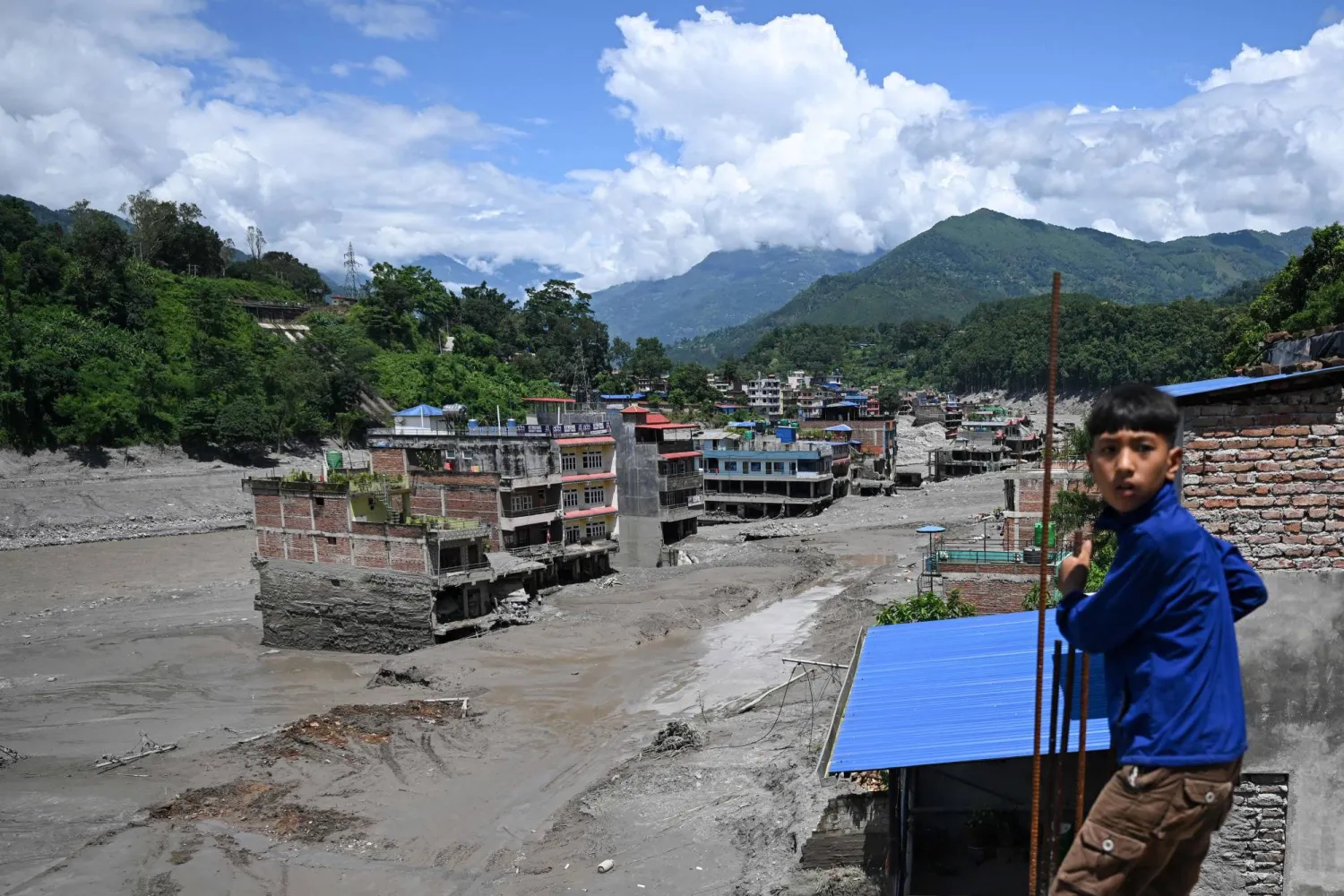
Emergency personnel extracted survivors covered in dark sludge and military aircraft transported stranded individuals to secure areas Friday as Nepal and China accelerated their responses to devastating flash floods that claimed over 500 lives and left more than 1,500 people unaccounted for. Nepal’s emergency management department confirmed the domestic fatalities climbed to 538, noting that in excess of 3,700 citizens have been successfully evacuated. Local law enforcement authorities later adjusted the national casualty figures upward to 547.
Concurrently, minimal details emerged regarding survivors across the Chinese jurisdiction, where the confirmed fatality count reached five on Friday as government-run broadcasting networks displayed rural evacuations and administrative leaders organizing the humanitarian response efforts. Chinese state outlets previously indicated that 558 individuals remained missing. Across the frontier, Nepal’s national disaster coordinating body reported Friday that 977 persons were still missing, with hundreds of those individuals identified as international nationals who traveled to the territory for employment, mountaineering expeditions, or religious pilgrimages to a sacred mountain peak.
Administrative bodies caution regarding subsequent deluges from an emerging body of water as regional law enforcement distributed a new warning Friday following updates that a retaining structure on the Tibet side collapsed. Protection forces and humanitarian workers were directed to maintain maximum readiness and relocate to protected elevations immediately if required. It remains uncertain if the structural collapse is connected to ongoing flood anxieties surrounding a blockage lake that developed following the primary flash flooding, situated at an extreme elevation within the Chinese territory of the Himalayan range. Chinese state network CCTV detailed that the body of water formed at an altitude of 2,950 meters (9,680 feet).

State administrators from both Nepal and China previously issued warnings regarding subsequent inundations from the blockage lake, which had already breached its natural boundaries. They instructed residents across vulnerable downstream zones to relocate to higher terrain. Nepal law enforcement representative Abi Narayan Kafle clarified to The Associated Press that emergency search operations were pressing forward under enhanced safety protocols. “Operations have not been suspended,” he maintained.
Even though the newly formed lake is situated in excess of 10 kilometers (6 miles) away from Gyirong Port, the heavily damaged boundary crossing connecting with Nepal, humanitarian forces traveling toward the impact zone received orders to temporarily halt operations Friday morning due to anxieties that the water body would burst its banks.
By Sumayya
Approximately 680 emergency workers ultimately arrived at the most severely devastated zone in Gyirong by walking and using inflatable watercraft after immense exertion. Several responders were lowered directly from specialized unmanned aerial vehicles deployed to the territory, according to television material broadcast by CCTV.
Large numbers of citizens have been successfully displaced, while alternative residents anticipate extraction as military rescue teams from the Nepalese Army focused operations on liberating personnel trapped inside a subterranean hydroelectric facility pipeline in Rasuwa, which forms a component of the Upper Trishuli-1 Hydropower Project.
Media coverage recorded at the location displays emergency personnel assisting an individual, completely coated in deep dark sludge, out from the industrial pipeline by utilizing pulling and pushing maneuvers. The rescued individual represents one of potentially dozens of personnel currently cut off inside the subterranean structure.
Military representative Brigadier General Raja Ram Basnet communicated to the AP that the primary operational objective remained centered exclusively on locating living individuals.
“It presents an extremely intricate challenge to identify the initial ingress and egress locations of the subterranean asset because the entirety of the infrastructure has been completely inundated by thick mud,” Basnet clarified. “Our primary organizational objective is the immediate extraction of all stranded citizens.”
The national emergency response department of Nepal confirmed that a total of 3,253 individuals had been transported via military helicopters out of the impacted impact zone. Affected citizens, encompassing severely wounded individuals, were transferred directly to Kathmandu alongside alternative regional destinations.
Multiple individuals experienced a sudden shaking of the earth, followed by the appearance of a dark, dense cloud.
Environmental researchers who evaluated orbital satellite photography indicated that a foundational section of bedrock situated beneath an elevated glacial formation within the Himalayan territory suffered a structural failure, dragging a significant portion of the ice mass along with it. The resulting rock avalanche was of such immense severity that it generated an active magnitude 5.2 seismic signature on tracking equipment.
The massive volume of rock debris and rapidly melted ice subsequently flooded the river channels winding through the low-lying valleys below, producing a violent surge of water that completely demolished buildings, transportation bridges, and natural terrain downstream across both Tibet and Nepal.
Border management official Karbir Gaire was numbered among the surviving residents within Timure, which stands as the nearest Nepalese residential settlement to the international frontier with China, where an estimated population of 1,500 citizens had previously resided.
Gaire entered his workplace premises at roughly 8 a.m. on Wednesday and was actively operating his computer station when he initially experienced the physical shaking of the floor beneath him.
“Immediately following that initial tremor, I observed what appeared to be a massive dark storm accelerating directly toward our location,” he recounted from Kathmandu, where he has since reunited with his household. “Every one of us instantly turned and fled the building, and within a span of mere moments, we were scrambling up a steep incline on the facing side of our workplace structure. I am convinced those brief 10 seconds or so are the reason some of us managed to survive.”
Gaire is unable to recall the precise count of personnel present inside the workplace facility during the onset of the catastrophe, though 15 of his professional associates remain completely unaccounted for. “The entire experience resembled a dramatic sequence out of a major Hollywood production. I refuse to characterize it as a mere flood; it was an absolute tsunami.”
