

By Sumayya
Toronto resident Josh Balon was browsing for meat options at his neighborhood grocery supermarket when he resolved that it might represent an ideal moment to consider backing a localized butcher establishment.
“I believe that if any individual possesses the financial capacity to back local… those independent small enterprises, I am convinced those are truly vital because they are going to suffer,” he recounted during an interview with CP24.com.
“They (major supermarket corporations) possess a significantly larger operational cushion to navigate the turbulent economic conditions compared to a neighborhood butcher shop.”

Balon represents merely one individual among a growing collective of Torontonians who have focused their attention on purchasing a higher volume of domestic commodities as the commercial dispute between Canada and the United States intensifies.
Fresh American import duties targeting billions of dollars of Canadian merchandise were officially put into effect on August 22, triggering the Canadian administration to declare an equivalent dollar-for-dollar counter-tariff response. Those retaliatory duties targeting hundreds of U.S. commodities span from 15 to 50 per cent and are scheduled to become legally active immediately following the Labour Day holiday.
Bilateral commercial negotiations collapsed during the preceding weekend after Prime Minister Mark Carney asserted that the United States presented Canada with what he termed a “bad deal.” An escalating rhetorical conflict between Donald Trump and Ontario Premier Doug Ford subsequently prompted Trump to authorize an executive decree aimed at altering the designation of Lake Ontario to Lake America.
The commercial confrontation has thoroughly captured media coverage across the country throughout recent days, and retail sector specialist Bruce Winder noted that the situation is a primary consideration for Canadians, who are currently evaluating the diverse mechanisms through which they can reinforce corporate entities operating inside the nation.
“(Citizens) are actively debating the issue at their workplace water coolers, and they are discussing it around their family dinner tables,” he observed.
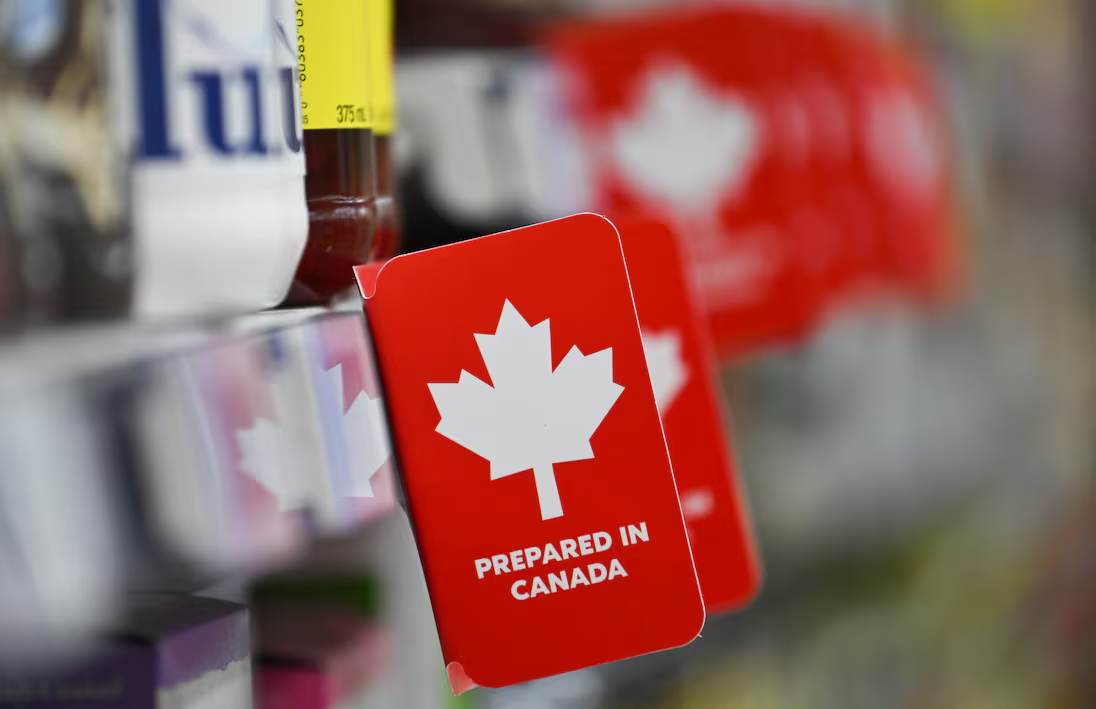
He highlighted that grocery giant Loblaw has recently brought back distinct ‘T’ branding markers on merchandise to explicitly show which specific items are being affected by the import duties, alongside utilizing a maple leaf emblem to clearly distinguish Canadian-originated products.
“That intervention will essentially serve to assist and steer the shopper for (those) individuals who truly desire to purchase Canadian-made options and who truly want to perhaps bypass select commodities that have faced cost adjustments due to the trade duties,” he analyzed.
He further detailed that Canadian shoppers have concurrently altered their behavior toward backing alternative domestic retail operations well outside the traditional food service sector, choosing to execute their purchases at Canadian Tire, Rona, or Dollarama instead of patronizing alternative U.S.-headquartered or global multi-national corporations.
Bruce Winder articulated that not every individual remains wealthy enough to completely invest themselves in the buy-Canadian consumer movement.
“I am convinced that represents perhaps the most substantial footprint an ordinary shopper can achieve is to patronize a Canadian-owned food retailer and concurrently attempt to evaluate product branding to purchase Canadian-made items whenever accessible,” he remarked.
Josh Balon clarified that throughout the preceding annual cycle, he has taken deliberate care to transition his food supply acquisitions to Canadian agricultural generators whenever it proves feasible.
One specific United States manufactured commodity he has permanently substituted for a domestic alternative is frozen ice cream.
“I have entirely migrated away and halted the purchase of those specific U.S. corporate brands, transitioning completely to Chapman’s varieties,” he recounted.
He highlighted that he additionally makes a deliberate point to execute his shopping trips at Canadian-headquartered supermarket networks.
“Diverse individuals are going to possess the ability to go to varying lengths regarding the financial support they provide to domestic corporate entities,” he observed. “I believe we ought to collectively execute what we can within our personal constraints.”
During a consultation with CTV News during the previous week, Brydon Parker, who originally established the digital index MadeInCanada.dev, verified that he has observed a “massive acceleration in user traffic” throughout the preceding several days.
According to statistical metrics shared by Parker, the web domain conventionally registers anywhere from 10 to 100 individual users during a standard operational day. Throughout this active week, that volume spiked to approximately 1,000 users during peak tracking windows.
“There exists a vast number of exceptional Canadian corporate enterprises that ordinary Canadian citizens remain completely oblivious about,” Parker communicated to CTV News.
“If they actually possessed awareness regarding their operations, they would be thrilled to execute their consumer purchases for those specific options rather than opting for alternative foreign substitutes.”
He detailed that he maintains the perspective that this wave of patriotic procurement will likely endure over the long term.
“Every one of us desires to unite collectively during periods of institutional challenge, attempt to reinforce one another, and determine how we can collectively prosper throughout the entirety of this situation,” he expressed.
‘Far From An Absolute Calculation’
Even though Balon conveyed to CP24 that he identifies a substantial degree of opportunity to reinforce localized merchants, he clarifies that he is not executing a blanket boycott against U.S. conglomerates that provide active employment to thousands of Canadian laborers.
“Those specific corporations, you know, they maintain formal executive headquarters, and they retain active workforces right here within Canadian borders,” he reasoned.
Winder concurrently analyzed that modern economic globalism has rendered it vastly more intricate to strictly purchase 100 per cent Canadian-originated commodities.
“You want to avoid sort of throwing the baby out with the bathwater. It represents a highly nuanced dialogue, and it demands a highly sophisticated methodology of analyzing the situation,” he noted.
“What I personally endeavor to accomplish, and I am convinced what a high volume of Torontonians endeavor to achieve, is simply to attempt to reinforce Canadian commerce to the highest degree possible, acknowledging that it remains far from an absolute calculation.”
