
By Sumayya
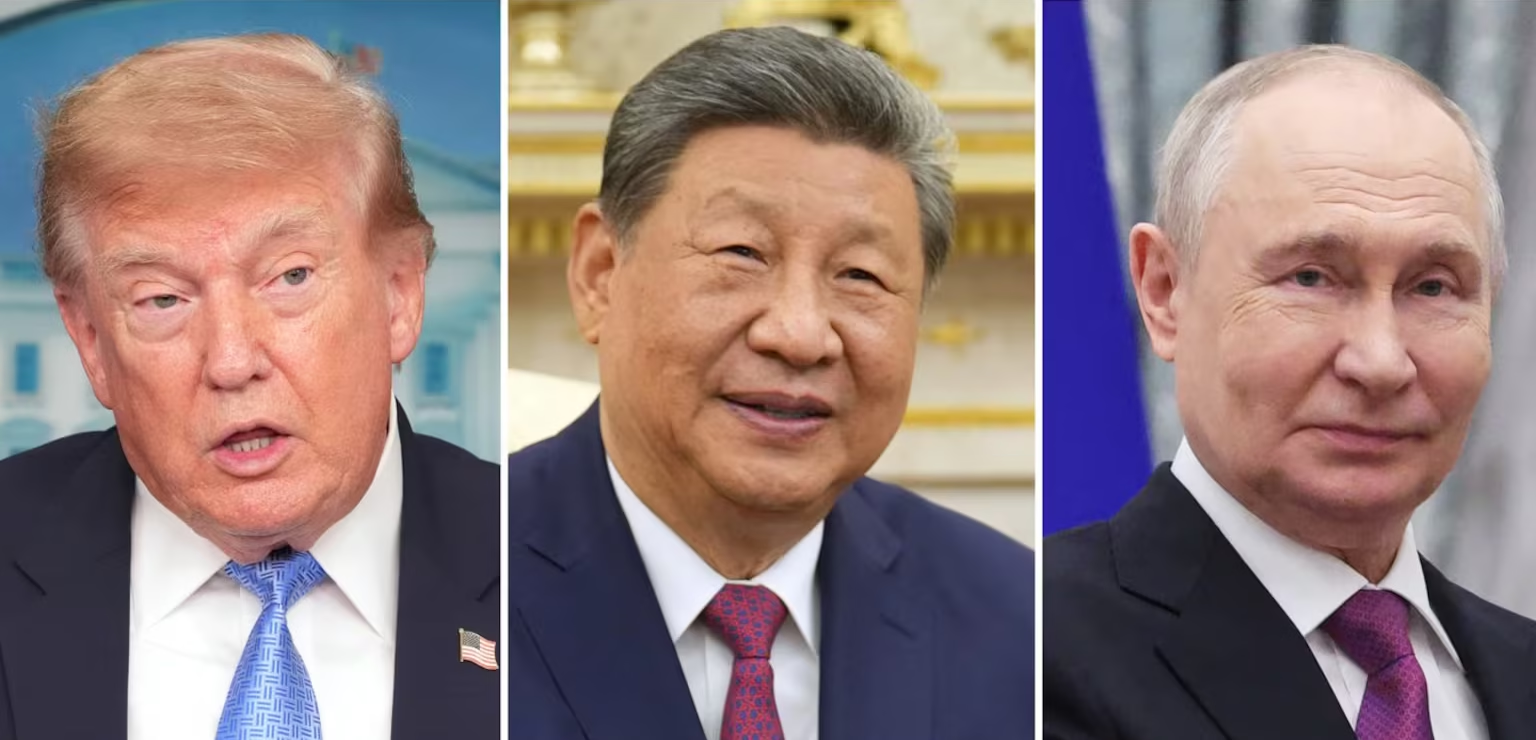
WASHINGTON — The top leaders of the United States, China, and Russia plan to sit down together Thursday on the edges of next week’s Asia-Pacific Economic Cooperation meeting in China’s technology center of Shenzhen—a never-before-seen gathering of the heads of the world’s largest nuclear nations.
While the leaders getting together for shared talks will mark a unique moment, political experts say hopes are low that the discussions will bring major results and note they will be heavier in public show than real action.
Plans for the three-way meeting with Donald Trump, Xi Jinping, and Vladimir Putin were verified Friday by the White House. It takes place at a tricky moment in friendships between the three countries.

Trump has warmly welcomed Xi after reaching a pause in their short trade fight last year and despite disagreements over the U.S. war with Iran and other tensions between the world’s biggest economic powers.
In the same way, Trump has tried to build his friendship with Putin, even as the Russian leader has continued his nearly five-year-old war with Ukraine and as Moscow has grown its military, spy, and political partnership with Iran.
The U.S. president has maintained that this kind of meeting would give a chance for the three leaders to talk about the U.S. war with Iran and his aim of getting a three-way deal on their nuclear weapon supplies.
Trump does plan on talking about the Iran war with Xi and Putin, but will stay away from talking about Ukraine, according to a high-ranking U.S. official who spoke to reporters without sharing their name.
The final nuclear weapons deal between Russia and the United States ended in February, lifting limits on the two biggest atomic weapon supplies for the first time in over fifty years. When that agreement—known as New START—ran out, Trump turned down a request by Russia to stretch the two-nation deal for another year and asked for “a new, improved and modernized” deal that brings in China.
The three-way meeting is meant to act as the “beginning of hopefully a conversation” on cutting nuclear weapons “that can be productive going forward,” stated the U.S. official, who added that no formal deals are expected to be shared.
However, Beijing’s collection of more than 600 nuclear warheads, according to Pentagon guesses, is much smaller than supplies kept by the U.S. and Russia, each believed to hold more than 5,000 warheads. With U.S. and Russian supplies making its collection look tiny, China has shown very little desire to build a nuclear deal.
Trump government officials admit that the nuclear weapon supply topic is a hard one for Beijing to join in on, but the U.S. official described the meeting as the moment for China to “step up … to the adult table” on an issue of worldwide importance.
Beijing Was Least Certain About the Value of the Summit
By saying yes to hosting the gathering, Xi might be thinking that the moment gives him a chance to show off China’s rising power and respect.
For the Kremlin, the planned three-way meeting is a deeply wanted opportunity to act as an equal superpower alongside Washington and Beijing.
“I think the key for Putin was that this was very much about signaling a desire to talk to the president and talk to Chairman Xi in a way that suggests that they’re making decisions on Ukraine, which obviously the Ukrainians and the Europeans don’t like,” shared Edgard Kagan, a past U.S. ambassador to Malaysia who now works at the Center for Strategic and International Studies.
The three-way gathering could easily steal the spotlight from the APEC meeting. The meeting, which is bringing 21 economies to Shenzhen, marks a huge moment for China to display its fast-growing, modern seaside city that changed from a tiny fishing village into a worldwide technology and money center in just a few decades.
More deeply, this kind of gathering could also confuse China’s claim that a Cold War mindset in the West was a reason that caused Russia’s war on Ukraine and its sharp blame that the U.S. has weakened world groups and agreements with how it has run its war against Iran.
The three-way meeting could hurt China’s effort to paint itself as a protector of free trade at APEC, noted Hoo Tiang Boon, a teacher of Chinese foreign policy at Nanyang Technological University.
“You sort of run counter to Chinese support of multilateralism,” he stated.
The Leaders Have Met in Pairs Plenty of Times Over the Years
Putin and Xi are no strangers to each other. They have grown a close personal bond, gathering over 40 times since Xi became president in 2013 and calling each other “dear friend.”
Trump and Putin have met in person on seven separate times, most recently in Alaska in August 2025. Xi and Trump have held in-person talks on eight times, including a September state trip to Washington by Xi.
Beijing is the top trading partner for Moscow, a bond that has grown stronger since Putin sent soldiers into Ukraine in 2022.
As the European Union and the West tried to cut off Russia financially, China raised its buying of Russia’s energy supplies and became Moscow’s main provider of important tech, including advanced parts for Russian weapon factories. Beijing has brushed off Western requests to stop those supplies.
Right before Russia’s war on Ukraine, Xi and Putin announced their nations shared a “no-limits friendship.” China officially has stated it takes no side in the fight, while claiming that Kyiv’s Western friends played a role in pushing Russia’s military strike in Ukraine.
Moscow, in return, has repeatedly stated its backing for Beijing’s rules on matters tied to Taiwan.
Trump recently made a diesel fuel deal with Russia, lifting financial penalties against Moscow and letting them sell millions of tons of the fuel. The U.S. leader has blamed rising energy prices on Ukraine’s strikes on Russian oil plants. Experts, however, say the jump in global oil prices is caused mostly by the Iran war.
Ukrainian President Volodymyr Zelenskyy has shared worry that the three-way meeting could act as a stage for talking about a possible Ukraine deal behind Kyiv’s back.
Planning for the meeting has brought comparisons to the Yalta Conference, the 1945 gathering where the leaders of the U.S., Britain, and the Soviet Union agreed to split Germany and Berlin into four military control zones and finished plans for creating the United Nations.
Kremlin spokesman Dmitry Peskov has brushed aside the Yalta comparisons, pointing out that any possible deals made in Shenzhen cannot be forced onto other nations.
“It’s clear that a meeting between the leaders of countries such as Russia, China and the United States is extremely significant,” Peskov expressed. “However, let’s not forget that the vision for a global order is that no one tries to impose any particular view of global order, and it should be based entirely on mutual benefit and mutual respect.”
