

By Sumayya
DEIR AL-BALAH, Gaza: It remains perhaps the most striking harm done to the Gaza Strip by Israel’s military campaign over the past three years: The city of Rafah, once home to a quarter million populations, has been wiped out.
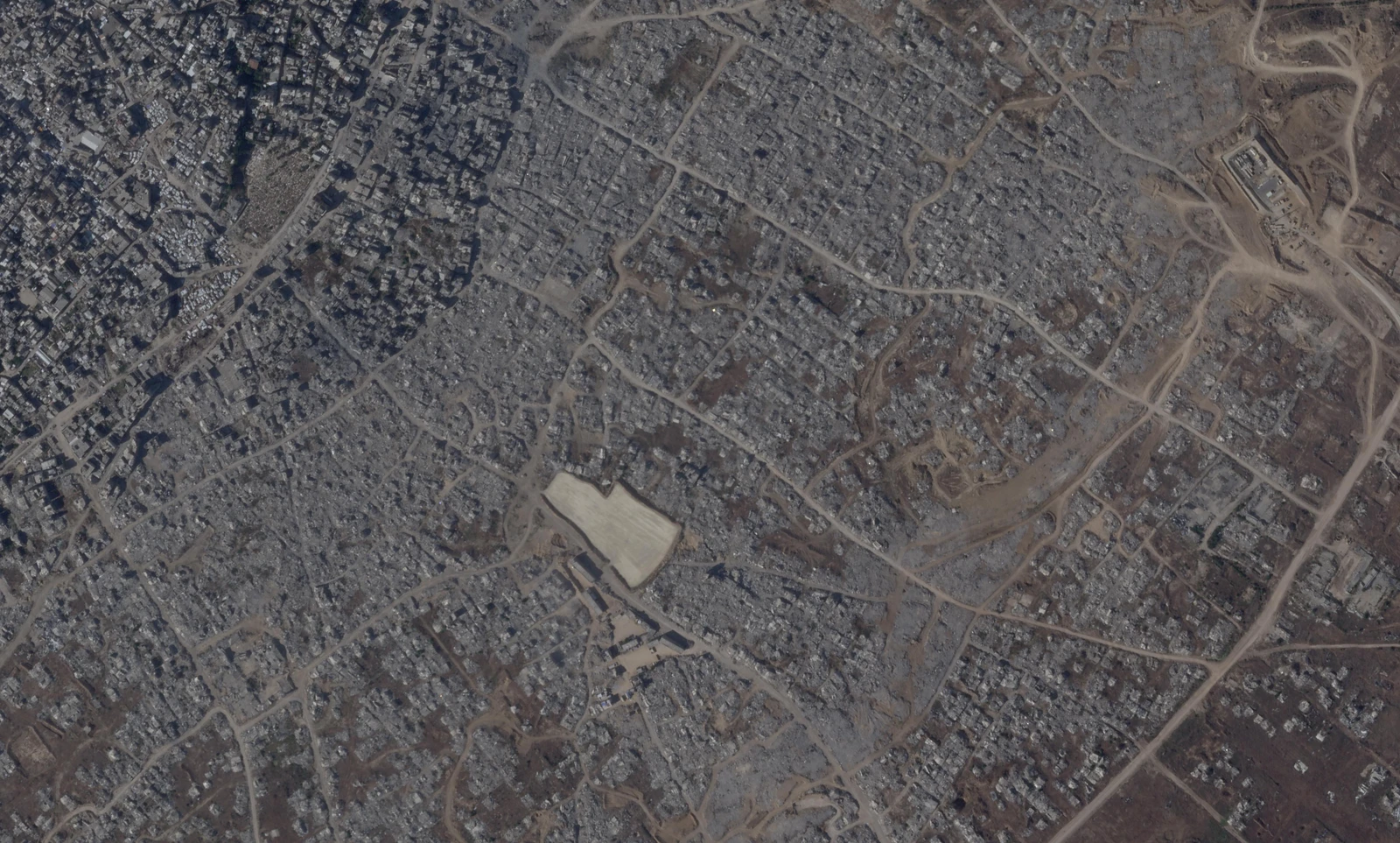
Space pictures display the Israeli military has systematically flattened the southern city and alternate towns and zones to the dirt and in some spots plowed away the broken bricks. Ruining buildings, using big tractors and bombs, has moved on without stopping since the Israel-Hamas truce deal reached a year ago, as the army makes strong its hold on just over 60 percent of the land that it still manages.
Gaza’s broken land remains merely single of the harms on top of harms that the area’s 2 million Palestinians have faced since Israel launched its drive to destroy Hamas after the fighters’ Oct. 7, 2023, strike on southern Israel.

More than single out of every 10 populations from Gaza’s pre-war total has been killed or hurt by Israeli fire. While near every lineage grieves dead or cares for hurt family, most likewise had to shift multiple times to escape fighting and Israeli orders to leave. With almost the entire total homeless, the coastal area remains now truly single of the planet’s most filled tent cities. Poor cloth and plastic shelters cover beaches and past farm lands and fill empty spots.
Little remains likely to shift for the near future. While the truce deal stopped the big attacks and heaviest bombing, Israel hits tents, cars and buildings near daily in strikes that it states focus on Hamas members — but that routinely kill women, youngsters and alternate family members.
Populations no longer hold to run from spot to spot, but few can rebuild houses because Israel blocks most building supplies from entering Gaza. The truce agreement’s plan for the large-scale rebuilding of Gaza has never launched because Israel and Hamas have failed to reach a deal on taking weapons away from the fighter group.
In the meantime, Palestinians struggle with heavy sadness
Najwa Abu Eita lost her 7-year-old girl when Israeli units hit her house in the central refugee town of Nuseirat in September 2024, and her three alternate youngsters were hurt in the strike. Abu Eita lost an eye, her face stays deeply harmed and marked, and she keeps trouble taking breaths.
A hair cutter before the war, she now keeps no job, living in a tent by the ruins of her house. Worst of all, she says, her youngsters remain scared by her face and avoid viewing her.
“My 4-year-old boy tells me, ‘Mother, I will give you single of my eyes.’ And inside, I remain crying,” she expressed.
On the Israeli-held flank, destruction moves on
Gaza’s total remains squeezed into near 40 percent of the tiny land, and Israel’s army manages the rest. Space pictures by Planet Labs PBC display that the massive majority of buildings in the Israel-held part have been plowed down or blown up into piles of broken bricks, much of it after primary fighting ended a year back.
The Israeli army says it ruins buildings to block their usage by Hamas fighters or to destroy the group’s underground tunnel paths.
But a UN-picked expert expressed in a February report that the scale of ruining civilian houses and basic setups in Gaza “is unmatched even by the terrible rules of modern war since the 20th century.”
The report cautioned that it could form a crime against humanity or reach the level of mass killing, which under planet law holds “deliberately placing states of life meant to bring about physical ruin.”
Israel turns down claims of mass killing, saying it focuses on Hamas fighters and their setups that remain mixed inside civilian zones.
The Planet Labs pictures display at minimum 50 Israeli army posts built throughout the Israeli-held part of Gaza, at minimum 18 of them built since the truce launched. Many have been placed on top of past neighborhoods where the broken bricks of ruined buildings nearby have been cleared away.
Most of Rafah stood flattened before the truce, but pictures display that troops move on to ruin the few remaining buildings. Several left UN buildings have been saved, as well as a town sports field that now appears to hold an army base.
A fresh base likewise stands on what stood once the main crossroads of the southern town of Bani Suheila. Leveled over the past year, the town remains now a wasteland crossed by a web of dirt tracks that were once streets.
In Jabaliya in the north, most of the Al-Awda Hospital Center stood turned to broken bricks in fresh months, as stood multiple UN-run school buildings, space pictures display. Jabaliya stood once home to the Gaza Strip’s biggest refugee town, home to near 120,000 refugees and tens of thousands of alternate residents in a tightly built city zone.
Now single of the few buildings still standing remains the eight-sided Indonesian Hospital, empty since troops shut it down in June 2025. The Israeli army built a fresh base nearby.
Similarly, most of Beit Hanoun, once a town of near 70,000 populations in Gaza’s far northeast corner, and Shijaiya, a Gaza City neighborhood set up 800 years back, remain now block after block of flattened houses and living towers.
Gaza’s market has been broken
A raised flow of aid and trading items brought Gaza back from food scarcity that came up in specific spots last year under a months-long Israeli ban on food and alternate goods. But most of the total stays dependent on international relief. Jobs remain few, mostly linked to selling in the market.
Shadi Barawi lost his father early in the war. Soon after that, Barawi stood hit by metal pieces from a strike near his house in Gaza City, and his leg stood cut off — single of near 6,000 populations with cut limbs left by the war.
After losing his leg, “I lost all hope in life,” the 35-year-old expressed. But he stood the lone support, he expressed, for his own lineage of six and his five sisters.
A barber before the war, he returned to giving haircuts to earn some cash. With no fake limb, he balances on his walking sticks as he performs in the identical tent where he lives.
“I remain performing in tough states,” he expressed. “I remain on single leg. I might do cuts for three buyers, then I get tired and stop and rest, but then I keep going,” he expressed.
Alternate populations still search for their dead
Thousands of bodies stay buried under buildings smashed by Israeli strikes. Since the truce, Gaza authorities have slowly been going from spot to spot to try to spot them.
Last week, a search team finally arrived at the Gaza City house of Haneen Al-Khodari. When her building stood hit in December 2023, Al-Khodari stood thrown into a nearby tree, and after weeks in the hospital, she stood informed her parents, siblings and many of her cousins were killed, she expressed. The bodies of 17 of them stayed trapped under wreckage ever since.
But after eight hours digging through the ruins, the team only found the remains of a small child and two bones. The search for the rest stood stopped.
Al-Khodari sat on the pavement, her hopes gone. “We had been waiting for this moment for three years,” she expressed.
A plastic sheet on the ground in front of her held what they’d found, marked with the words, “Mixed bones.”
